

AAG Technology Consulting President and Founder Aelin Golsarry chuckled and texted a colleague during a presentation at Canalys Forums Americas on Nov. 10. The keynote topic was a shift to outcome-based pricing among systems integrators' billing models
Golsarry's Phoenix-based consultancy and systems integrator has been billing for outcomes for years.
"[GSIs are] coming to the light," Golsarry said after the keynote. "This is what they've always wanted, but this isn't new."
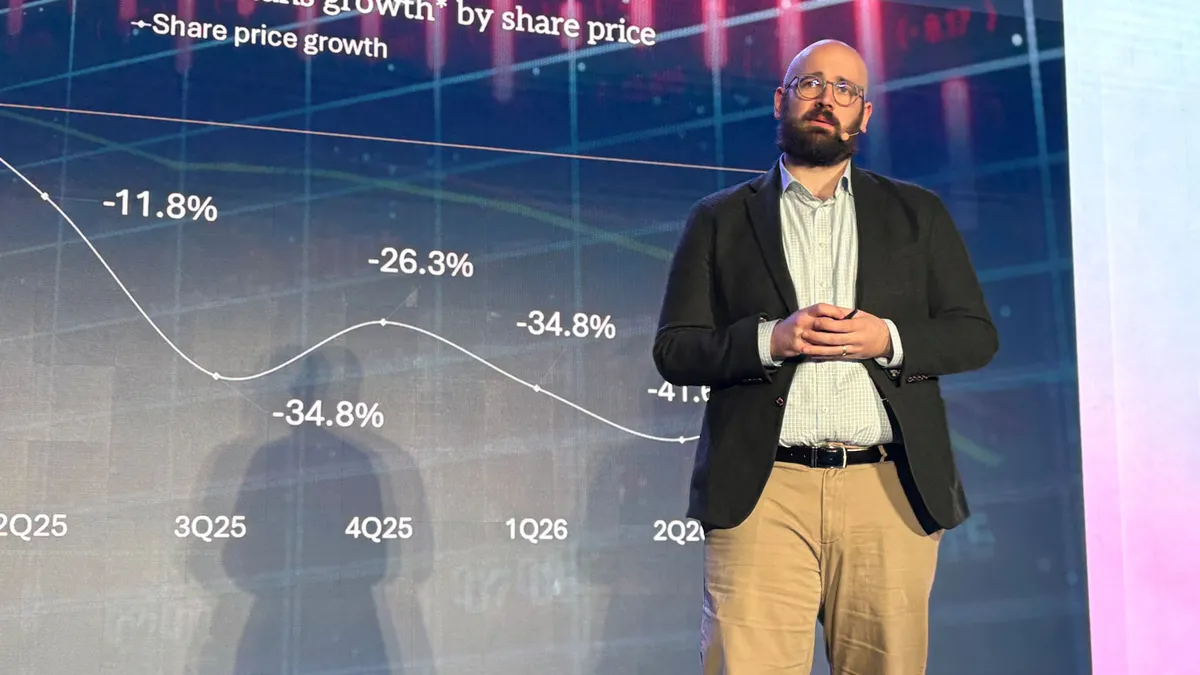
Global systems integrators will lose market share over the next four years as smaller players push upmarket, according to a recent industry forecast by Omdia, a Channel Dive sister company. The analyst firm expects regional SIs to own 30% of the North American market by 2030, a roughly 10-point gain over the current share.
As midmarket and enterprise customers struggle to adopt and pay for AI, smaller partners that are closer to their clients and can orchestrate relationships with other channel companies are primed for success, according to Peter Bryant, Omdia research director of North American channels and GSI practice lead.
"Their ability to own that customer on an industry level will be their difference," Bryant said during a keynote.
GSIs, including channel behemoths like Accenture and Deloitte, are scrambling to find an identity in the agentic AI era, testing outcome-based pricing, developing strategic practices for LLM modelmakers, expanding managed services and setting up shop in the midmarket. Those efforts may not be enough. Inflexibility, slowness and overstaffing contributed to a GSI growth slowdown highlighted in the 2026 Omdia Global Partner 1000.
"GSIs have had two years to match their expectations of the market, and they missed those expectations," Bryant said. "The lessons that should have been learned from the beginning of the cloud era have not been applied to this new era of AI."
Smaller, regional SIs are better positioned than the giants. While they aren't as well stocked with technical talent, data storehouses and capital, they're nimbler.
"Their ability to deliver on those outcome-based pieces in terms of their business model is better and more quickly adjusted than those large GSIs," Bryant said.
GSIs have historically benefitted from their ability to provide a broad range of services. The services gap has narrowed as value-added resellers add managed services, managed services providers offer professional services, and technology advisors deliver consulting services. Omdia polling found that the average partner offers three different types of professional services.
"[GSIs] are not the only jack-of-all-trades merchants in the market anymore," Bryant said.
"The traditional land-and-expand into the enterprise is no longer enough."
Even the pivot GSIs are making to managed services doesn't mean what people think it means, Bryant warned. The firm reported that more than 50% of its revenue for the fiscal year ended Aug. 31, 2026 came from managed services — technically meeting Omdia's definition of an MSP.
For Bryant, Accenture's managed services push indicates that the company has reached the "end of the road" in its current segment. The $74 billion company grew its revenue 3% organically in local currency in its latest fiscal year ended Aug. 31. Growth rates were similar at other GSIs; Deloitte grew 3.8% in local currency for the fiscal year ended May 31, 2026, and Capgemini grew 4.8% year-over-year in constant currency in its Q3.
"They will need to enter a new market entirely to continue to grow," Bryant said.
Accenture set a full-year revenue guidance of 3% to 6% for the upcoming year in its Oct. 1 earnings report, and Chair and CEO Julie Sweet expressed confidence in the company's strategy.
"We continue to believe the opportunities related to AI are greater than the impact of AI-related efficiencies on our business, and we expect that to continue as AI enables enterprises to do much more," Sweet said.
Accenture did not provide a comment to Channel Dive as of the time of publication.
Midmarket collision
Accenture launched a standalone midmarket business in June with managed services on the menu.
The business unit is aiming to overcome cultural obstacles that keep GSIs from gaining midmarket ground, according to Bryant. Managing directors at a GSI receive prestige and investment for landing bigger and bigger customers, not smaller ones.
"There is no glory in the midmarket," Bryant said.
Accenture and its GSI peers bring real strength to the midmarket, particularly the ability to collect data across a business's digital transformation process — data that informs the GSI on where to upsell, Bryant said. They are packaging services with an eye on midmarket budgets.
The GSIs are not alone. Technology advisors sell network and communications to multi-location businesses and cross-sell managed IT and security services into the same accounts. Private equity-backed MSPs are bringing vertical strategies into midmarket accounts — fueled in part, according to Omdia, by rising interest rates that have forced investors to create platforms.
The segment is becoming a partner pileup.
"I don't think ever there has been more pressure in this middle of the channel ecosystem," Bryant said.
Knowledge of the customer will be the single biggest differentiator.
"There's so much complexity that goes on into these environments and so much noise, you can be really technically proficient and have all the capital in the world, but if you don't understand the core of your customer problem, you're going to have a real issue," Bryant said.
AI priorities
The real opportunity for all partners is routing their customers through the many questions they'll need to answer on their journey to adopting AI, Canalys founder Steve Brazier said in his keynote.
"Guiding your customers and telling them how to run AI, how to route AI, how to lower costs and increase efficiency is absolutely the number one priority for 2027," Brazier said.
Many clients still have a very vague idea of AI and how they could benefit from it, but IT leaders are facing pressure from the board to try it, Golsarry told Channel Dive.
"Clients come to me and say, 'Hey, I think I should do AI. I don't know what I want to do, but I should do something,'" said Golsarry, who works with organizations that have $100 million to $2.5 billion in revenue. "That's a lot of money for something."
Golsarry hasn't seen budgets rise to the level of AI ambitions. Businesses want to work within the confines of what they usually spend, she said. "No one has been like, 'Here's a check; make it so.' Everybody wants it fast; Everybody wants it cheap."
Technology isn't going to solve the problem, and Golsarry said AAG doesn't start there. Golsarry can count at least three examples where a vendor has promised an outcome it failed to deliver because it didn't understand the ins and outs of the customer's business.
Those anecdotes validate AAG's cross-functional approach to consulting, Golsarry said. Infrastructure, business processes and change management are just a few of the categories the firm aims to integrate.
"We'll have about 27 different work streams going concurrently," she said. "We did a year's worth of work in 15 weeks this past year, so it's really a group effort for all of us."