

Cloud Communications Group is banking on a digital version of its consulting business to deepen ties with IT buyers as committee buying complicates the procurement process.
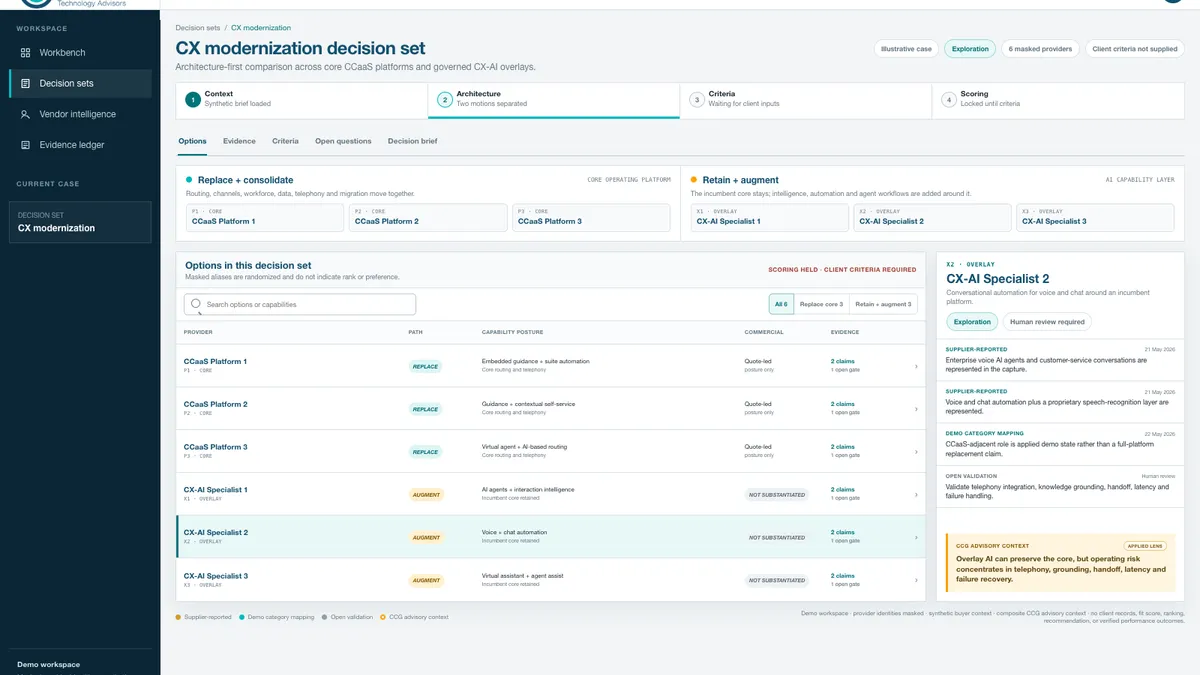
The Dallas-based technology advisory firm will launch its decision intelligence platform InsightForge next month — combining information from the company’s 19-year consulting history, timing triggers, enterprise technology procurement workflows. CCG has started showcasing the tool among customers and will soon issue client logins, following following months of internal testing.
At a time when IT leaders are asking chatbots for consulting advice, CCG is offering InsightForge as a free, LLM-agnostic data set. The company aims to give clients deeper context into past and present buying decisions.
“We've always had that information, and now what we've got is a tool that allows us easier access to that, so it's providing somebody with all of the artifacts,” CCG Partner and Co-Founder Keith Hatley told Channel Dive.
The platform is designed to give purchasing committees visibility and continuity throughout the product life cycle and position CCG front and center.
Vendors and partners sell technology and services to CIOs and IT directors, but those executives must then effectively sell their purchases to the rest their team. For many IT leaders, the committee buying process is a new experience or one they don’t do regularly.
CCG helps buyers navigate the complexities of procurement-by-committee, moving beyond vendor recommendations. InsightForge is the digital version of that process.
“What does an IT leader need to promote a decision laterally, get buy-in from the rest of that person’s team, and then vertically? We kind of reverse engineer our process, and the artifacts that we supply are based on thinking about the problem that way,” CCG VP Business Development Tyler Dool said.
InsightForge could be a balm for executive turnover, particularly among flighty CIOs. Global digital leaders average a tenure of 3.3 years per company, according to the 2025 Nash Squared Digital Leadership Report. Companies can easily lose track of their IT roadmaps and purchasing history as a result. The same can happen for IT leaders that stick around for multiple projects.
“It would be great if when you're working on that seventh project, the intelligence you're leveraging for that seventh project is also aware of the other six and how those decisions were made,” Dool said.
The relationship-heavy TA model is uniquely vulnerable to executive turnover. Partners are recognizable through letters of agency written to vendors by customers rather than by invoices. An incoming CIO may not know a TA sold their company a certain technology product.
“The CIO doesn't necessarily say, ‘John Smith, we want you to work with CCG on this project,’” Hatley said. “It's just, ‘John Smith, we want you to go work on this project.’ There are times when honestly we just get left out of the decision for one reason or another.”
Giving everyone in the buying committees a login to the dashboard not only aids in the buying process, but it keeps them from forgetting CCG.
A study shared by the AI Revenue Institute earlier this month found that frontier model AI assistants are pervasive in the buying process. IT leaders are fact-checking vendor sales claims against publicly available information and scrutinizing the very partners who introduce their vendors.
In an age where anyone can scrape the internet, the ability to collect and organize domain-specific data about their clients could differentiate TAs.
“I keep going back to the enterprise context,” Dool said. “I think that's a moat for a lot of people if they can figure out how to leverage that.”