


IT vendors fear customer churn. Technology advisors should too, according to a recent Telarus report.
The technology services distributor surveyed of 501 IT leaders and found that 84% are open to changing providers at the end of a current contract. The TAs in the middle may be asleep at the wheel as customer needs and rising costs erode loyalty to incumbent vendors.
Telarus executives framed the finding as an opportunity for TAs. In a survey of 450 TAs that accompanied the report, only 14% said their clients rely on them for renewal strategy.
On the face of it, it’s a surprisingly low number for a business model that receives monthly vendor sales commissions for the lifetime of the customer. But external and internal pressures and the sales-oriented backgrounds lead many TAs to set and forget.
“They are by and large new logo hunters, and farming is potentially less interesting,” Telarus Chief Marketing and Experience Officer Jen Dimas told Channel Dive at the Telarus Partner Summit last month. “But you’ve already paid the cost of customer acquisition. You've already provided value. Have another conversation about what else you can do to help them.”
TAs tell Channel Dive they’re stepping up their post-sale engagement. Partner firms are building software to help clients oversee the contract lifecycle, and Telarus is sharing education content for renewals strategies to complement its renewal opportunity checklist.
“There's such willingness to change and open that conversation and it's an important part of the lifecycle process to get right, so we're going to be directing a lot of energy to that,” Dimas said.
Time constraints
Time is one impediment that keeps TAs from reaching out to clients about renewals.
Many TA firms are small shops with limited sales forces. The personnel crunch makes it easier to focus on new clients while hoping residual commissions from existing clients doesn’t drop off.
Larger TAs have hired customer success managers for existing clients, but success has been mixed. Clients loyal to a specific person rather than the brand have reason to switch TAs when their account manager changes.
“That's tough in any industry,” Opkalla CEO and Managing Partner Aaron Bock said. “I think you have to have a specific detailed process around it.”
Even when the original salesperson keeps their account, the seller still might not feel incentivized to help with the renewal. Some TA firms primarily pay their salespeople for acquiring new logos.
“If it's not the owner or the operator, somebody should be compensated and responsible for those renewals,” Prelude Solutions Chief Commercial Officer Bob Healey said. “That's also how you find new sales.”
TAs also shy away from chasing renewals because they don’t want to lose a customer. When a client’s CIO departs, the partner has to pivot. Because TAs don’t directly bill the client, it’s easy for the TA to disappear completely out of sight — while its the revenue stream persists. If it reintroduces itself to the new CIO and makes a bad impression, it could lose the account.
Bock isn’t a fan of a passive approach to renewals.
“Our mission statement is to help someone make a better technology decision every day. So if you're not doing that, you’ve got to ask yourself: are you a technology advisor?”

Aaron Bock
Opkalla CEO and managing partner
A platform solution
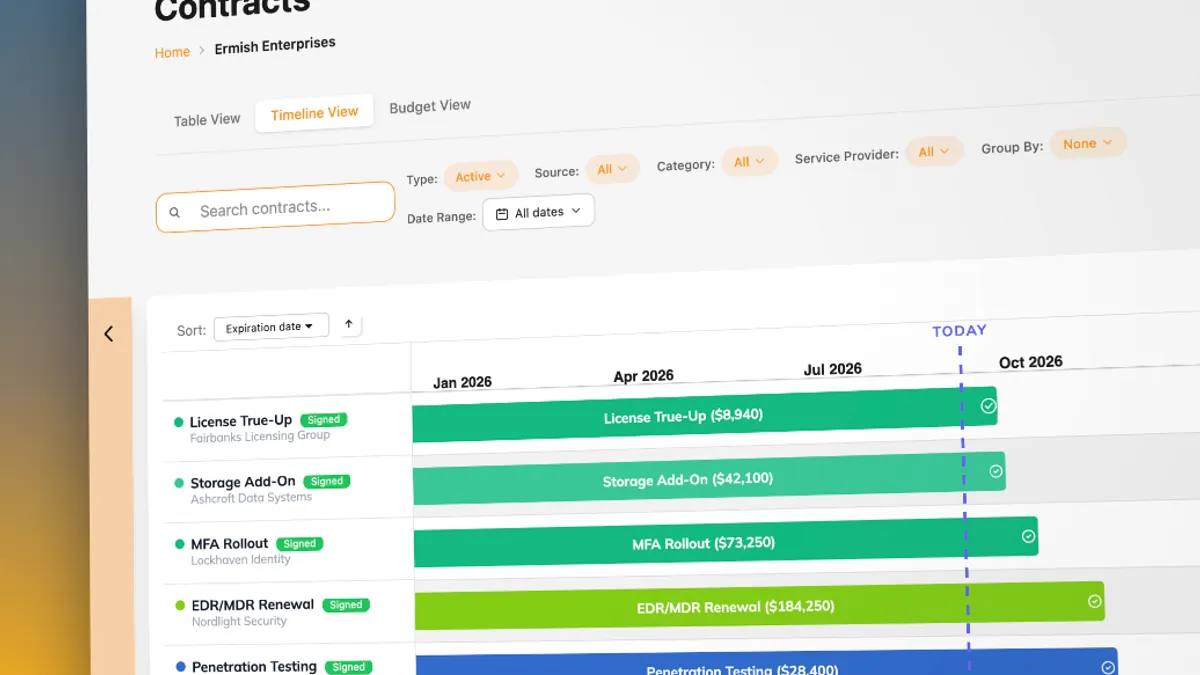
TAs that accurately track contract end dates have a distinct advantage over those that don’t. Dashboards and portals are becoming industry table stakes as software development barriers lower and the industry moves out of spreadsheets.
Opkalla is gearing up to launch a contract and renewal management platform for clients and advisors. Born out of feedback from customer advisory councils, the dashboard initially tracked Opkalla-sourced contracts. Its scope has expanded to include outside products and services.
It’s part of a broader push to stay close to the customer that includes quarterly business reviews and informational sessions on Microsoft licensing updates.
“I just don't think we're doing our jobs if we're not constantly in front of the customer and also sharing things that are important to them,” Bock said. “Wouldn't you want your insurance agent to tell you that we've got a renewal coming up?”
Eclipse also tracks products and vendors it didn’t sell. Lifecycle management of the entire IT stack is crucial to feed the core brokerage business, according to Eclipse Director of Advisory Linzee Safron.
“Now I know when X-Y-Z contract is up in a year and I didn't sell it,” Safron said. “This is an opportunity for me to use that renewal to sell a replacement.”
If TAs want to engage on renewals, they need to start early. Saffron said it’s important to begin the conversation with a client a year in advance. That doesn’t necessarily mean the TA and client will commence a full-blown renewal, but it gives both parties a chance to clarify how they are leaning.
“The renewal itself is really like a point in the calendar of, what are we going to do with this in the next 12 months?” Safron said. “If it's not a top priority or doesn't feed into a big technology initiative, then you don't want to spend a lot of time on it, and the customer doesn't either.”
Vendor management
Not all vendors want the TA involved in the renewal process, according to Healey.
When a TA discovers that a client is unhappy with the vendor or a price change, the renewal process can include bringing in quotes from other vendors.
“There's a little bit of, ‘We [the vendor] have earned this renewal; why would you, as our partner, compete against this?’” Healey said.
Healey sees room for compromise. The vendor needs to recognize that it has already made a profit on a multi-term customer, and the partner needs to demonstrate that it is providing value to both parties. Prelude often looks to extend the term while lowering the cost, all the while looking for ways to bring in additional services for the incumbent vendor.
“The goal is always to collapse as much as we can with one provider, give them long-term contracted revenue, give the client lower costs, and obviously that benefits us with more compensation,” Healey said. “If it's done in the right way, you can work with the provider to lower cost and not have to go through a protracted process that is torture for the supplier and potentially for the customer.”