

Xtium’s road to growth runs through partners.
The Florida-based firm is 14 acquisitions and more than a decade into a journey from hardware reseller to a cloud-focused MSP with north of $230 million in annual revenue.
In 2014, the company saw that customers were asking for a different consumption model than capex-heavy equipment purchasing. Xtium was also hungry for consistency the value-added reseller model couldn’t provide.
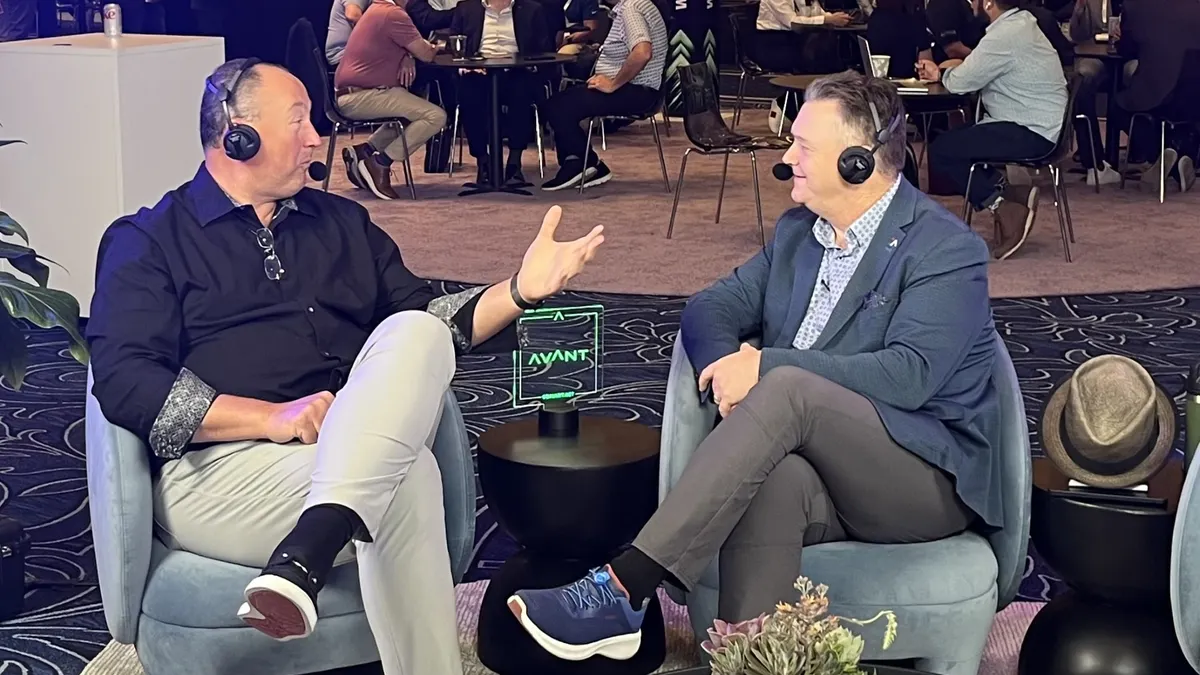
“We were looking for something that could smooth out the peaks and valleys of being a VAR in business,” Xtium Executive Vice Chairman Frank Scanga told Channel Dive at the Channel Partners Conference & Expo last week, “It's either feast or famine.”
As the company swells in size and moves up-market, its indirect sales channel is growing. Approximately half of the company’s deals now come from partners, but Xtium is aiming for 80%.
“If you look at most of our opportunities and deals that we're closing, they're coming from the channel,” Scanga said. “Obviously it's a much more qualified lead and opportunity, shorter time to close, and usually there's a bigger upsell opportunity because of the channel relationship.”
The RunTide Capital-backed company was known as ATSG before its 2024 acquisition of desktop-as-a-service provider Evolve IP. The channel partly inspired the rebrand. Scanga said partners weren’t familiar with the ATSG brand and didn’t associate Evolve IP with managed IT and network services.
“We also looked internally at our structure and how we best position ourselves to be a channel organization,” he said.
Scratching and clawing
Xtium is a poster child for the scaled MSP, which functions as both a partner and a vendor. The company resells and manages product from giant OEMs such as Cisco and Microsoft, while banking on its field of channel partners for go-to-market. Technology advisors and global system integrators are introducing the MSP to mid-market and enterprise customers.
“We look at the channel as a three legged stool,” Scanga said.
Evolve IP had worked with TAs and tech service distributors for decades, and ATSG leadership saw the acquisition as an opportunity to springboard into the market.
“We tried as ATSG to break into the channel, but there are so many suppliers trying to break into the TSD world and become a supplier,” Scanga said. “We were scratching and clawing but never really had the success to penetrate. They had a very mature sort of relationship in the channel, and we saw that that was a great value for us as ATSG.”
General contracting
Over the last several years, GSIs have started turning to Xtium and other large MSPs. If the GSIs are the enterprise’s general contractor, Xtium is the subcontractor that’s brought in to fill in gaps. Large consultancies and GSIs boast about their managed services revenue, but many of those dollars come from partners.
For example, a GSI tapped Xtium to manage the network for a division within a Fortune 100 food company.
“They actually used our instances of ServiceNow and they tied other parts and pieces into it,” Scanga said.
Thanks to consolidation, some MSPs have finally grown large enough for GSI to trust. Xtium finally reached the threshold four or five years ago, Scanga said.
“There's a lot smaller, mid-sized MSPs out there, and unless [they have] something unique, those SIs are not going to look to partner with somebody that small, because it's going to jeopardize their relationship with their contract,” he said.
There are often multiple partners engaging with a GSI.
“They may look to outsource the help desk from Partner A, they may look to outsource the security from Partner B and the managed network services from an organization like us, and they act like the GC,” Scanga said.
GSI attitudes towards managed services, and who provides them, are subject to change.
“Like everything, their business ebbs and flows also. ‘It's cool to outsource. Now we're going to insource. Okay, now we're going back to outsourcing,'” he said.