

Vendors are dismissing the agency sales model based on bad math, according to a new report.
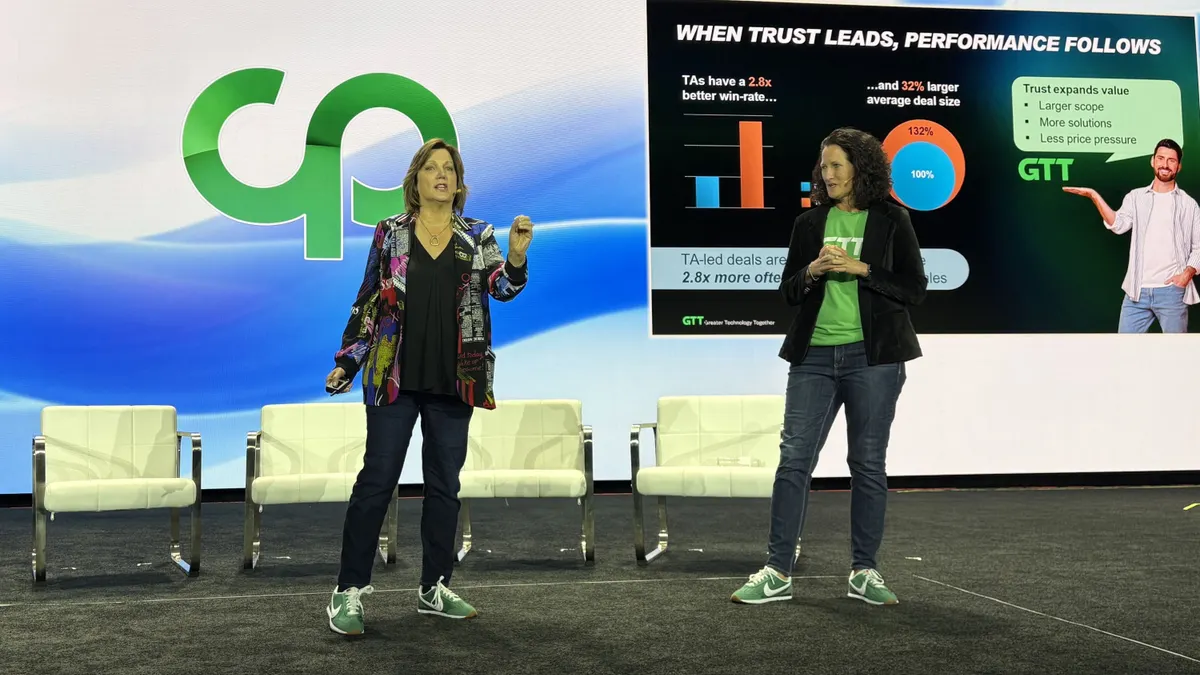
Trade association Technology Channel Sales Professionals last month published a study by JSG Channel Consulting comparing the costs of selling through technology advisors versus direct salespeople. The study, based on interviews with more than 100 partners and analysis of data from the vendors JSG consults, found that TAs provide a 25% lower enterprise customer acquisition cost than direct sellers.
“A lot of the suppliers have long believed that this channel is more expensive than the direct routes, and they've been kind of reluctant to believe that it's not for a lot of years,” Janet Schijns, CEO and Co-Founder of JSG told Channel Dive at the Channel Partners Conference & Expo in Las Vegas last week.
Opposition to the TA model often comes from financial leaders.
The study found that the majority of CFOs consider sales through partners more expensive than selling directly, and 44% considered TAs the most costly route to market. The sticking point is the long-tail commissions vendors pay partners for the lifetime of the customer.
Evergreen partner commissions motivate renewals, however. JSG found that TAs average customer retention is 9.7 years, versus 3.7 years for direct sales, creating a 69% lower annual churn rate.
“I hear from vendors all the time, ‘I don't mind paying for acquisition, but I don't know why I'm paying for residual,’” Schijns said. “This data shows them that if you let the partner acquire and continue to manage the account, it is far better for your company than it would be for you to not pay for it.”
Schijns also blamed reductionistic math. Finance teams often benchmark TA costs solely against the cost of sales and don’t factor in customer acquisition, marketing savings, or travel and expenses.
“You know what you should do? Not lower your channel compensation; fire your FP&A guy or whoever it was who said this is what the costs are, because they apparently can't do math,” Schijns said.
The indirect payoff
Tapping a tech services distributor to sell through TAs costs vendors. In addition to paying residuals, the supplier needs to staff channel managers who can support partners, and it needs to market to the TAs if it wants to be visible in a stacked vendor line card.
Channel investments are worth it, Xtium Executive Vice Chairman Frank Scanga said. The managed services provider had eyed signing an agreement with a TSD before acquiring Evolve IP, which was already entrenched in the market.
Still, the C-suite at Xtium needed to fully grasp the model.
“We had the board and ELT scratching their heads saying, 'What are all these commissions we're paying on a monthly basis? God, that's expensive,’” Scanga said.
When the company compared the pipeline growth it was getting from TAs, the cost difference looked null. Moreover, TAs were helping Xtium close deals faster. JSG found that TAs close deals 37 days faster than direct on average.
“Think about how many people are floating around here,” Scanga said in reference to the Channel Partners Conference & Expo. “I have 10,000 sales reps, and I don't have to pay them a salary.”
Agency is not the only type of indirect motion. Schijns said CFOs often have an easier time signing off on resale programs, especially pure wholesale. However, most resale programs have significant staffing expenses and level 3 and 4 ticketing support.
Nevertheless, both types of indirect sales blow direct sales out of the water, Schijns said.
“Maybe in SMB you're better off on a marketplace, and maybe in midmarket you're better off in a MSP motion, and maybe in large enterprise you're better off in a TA motion,” Schijns said. “But that's called a go-to-market strategy, not a cost-of-channel exercise.”
Re-telling the story
Channel leaders are battling widespread stereotypes about TAs and TSDs.
“There's this urban legend that there's these beings roaming around the channel that are looking to suck the blood out of a company,” Schijns said.
Devan Adams, who researches the TSD model and telco channels for Channel Dive sister company Omdia, said he has heard pushback on residual commission from the C-suite — and even some channel chiefs. Those executives believe TAs are showing up for the sale and then walking away.
“This skepticism often stems from a narrow view of the value TAs provide, focusing solely on their visible engagement points rather than the broader impact they have on customer acquisition, retention, and satisfaction,” Adams said. “The misconception that TAs are being paid for minimal effort overlooks the role they play in building trust, influencing buying decisions, and maintaining long-term customer relationships — areas where direct sales teams often struggle.”
There’s work to be done inside the industry to tackle stereotypes of absentee agents.
TSDs, TAs and third-party industry associations evangelize the model to customers and vendors, they’re developing internal codes of ethics.
TCSP President Bill Power said 50 TAs are lined up to take a proof-of-concept certification program with the trade association. It’s designed to increase professionalization in the industry and help customers steer clear of bad apples.
“We've got to build an enforcement effort, so when somebody misbehaves, what happens? I understand that those are tricky things, but we understand that, and that's part of developing that stuff concurrent with this group.”