


TPx Communications is on track to continue paying commissions amid its Chapter 11 bankruptcy. But what will happen to its channel partners if the company successfully completes a sale?
The company, once known as TelePacific, filed for bankruptcy with the U.S. Bankruptcy Court for the Southern District of Texas June 28, declaring that it needed to clear $1.1 billion in debt — of which some $300 million is due this year. The firm asked the court to continue its commission program for employees, independent contractors and third-party sales agents; it currently owes agents $3.2 million. TPx has contracts with approximately 130 sales partners, some of which are technology services distributors with sub-agents.
“Maintaining historical practices is essential to ensuring that the debtors can retain their employees and independent contractors and continue to operate business and maximize value through the duration of these Chapter 11 cases,” Chief Restructuring Officer Steven Shenker wrote in a filing.
The court on Monday authorized TPx to continue customer programs, which should keep commissions flowing.
It’s business as usual for the company, TPx CEO Shawn Andrews assured partners in an emailed statement to Channel Dive.
“By significantly reducing debt, TPx is well-positioned to accelerate innovation, expand its capabilities, and build on the strong EBITDA performance and free cash flow growth achieved in recent years,” Andrews said. “Channel partners should see no impact to our relationship, contracts, or commissions at this time, and we remain committed to delivering industry-leading payouts, engagement, and support to achieve mutual success. We'll continue to work together to provide the excellent services our customers expect."
Max Clark, CEO of TPx partner ITBroker.com, said he and his peers aren’t worried about commissions in the short-term.
“Unsecured creditors — vendors and outside sales agents — are going to get preference clawbacks from the trustee,” Clark told Channel Dive in a message. “This will be a mess and painful for anyone impacted."
Clark expects that it will be three or four months before which creditors are deemed essential inn the restructuring plan.
Longterm, it’s likely that partners who work with TPx via contracts held by national TSDs will be safe. The 2019 Windstream bankruptcy, in which the carrier slashed hundreds of agent agreements, spurred partners to move under larger TSDs.
“I’ve long believed that part of the TSD value is this exact scenario — specifically that future sales revenue via the TSD channel will require preferred treatment, but we’ll see,” Clark said.
It’s rare for bankrupt vendors to attempt to stop paying residual commissions to TSDs, as vendors rely on them for future sales. But if they do, TSDs typically enter binding arbitration with the vendor to force them to honor their agreement. It’s a process that takes time and money and could financially ruin a small partner.
“We have defended our trusted advisors’ commissions many times, more than you would think. We can’t mention the names of the vendors or any of the specifics for confidentiality reasons, but they include some large multinationals,” Avant Chief Strategy Officer Alex Danyluk told Channel Dive. “It’s a key reason you don’t want to have a direct contract with a vendor. The effort doesn’t start when a problem arises. It starts upfront when we discuss a channel agreement with a vendor. We spend a considerable amount of time in negotiating the contract, and the results speak for themselves.”
Commissions are one issue. Another unknown is what TPx will look like if its Chapter 11 protection goes according to plan.
TPx intends to put its assets up for sale in an Aug. 12 auction and install a stalking horse bidder to set a minimum price. The court approved the plan on Monday, according to court documents, authorizing TPx to seek a stalking horse ahead of the Aug. 7 bid deadline.
A sale deal could give TPx a debt-free lease on life, but it could also lead the MSP to being stripped for parts. Its managed connectivity and networking business, which the firm admits is its largest, could be separated from TPx’s managed IT, and cybersecurity and unified communications practices. TPx has styled itself as a converged provider of networking, IT and security services over the last decade and brought on private equity firm Siris Capital Group to help fund the evolution.
Andrews noted in a public letter Monday that some of TPx’s debt is “tied to our legacy business no longer aligned with the future we are creating.”
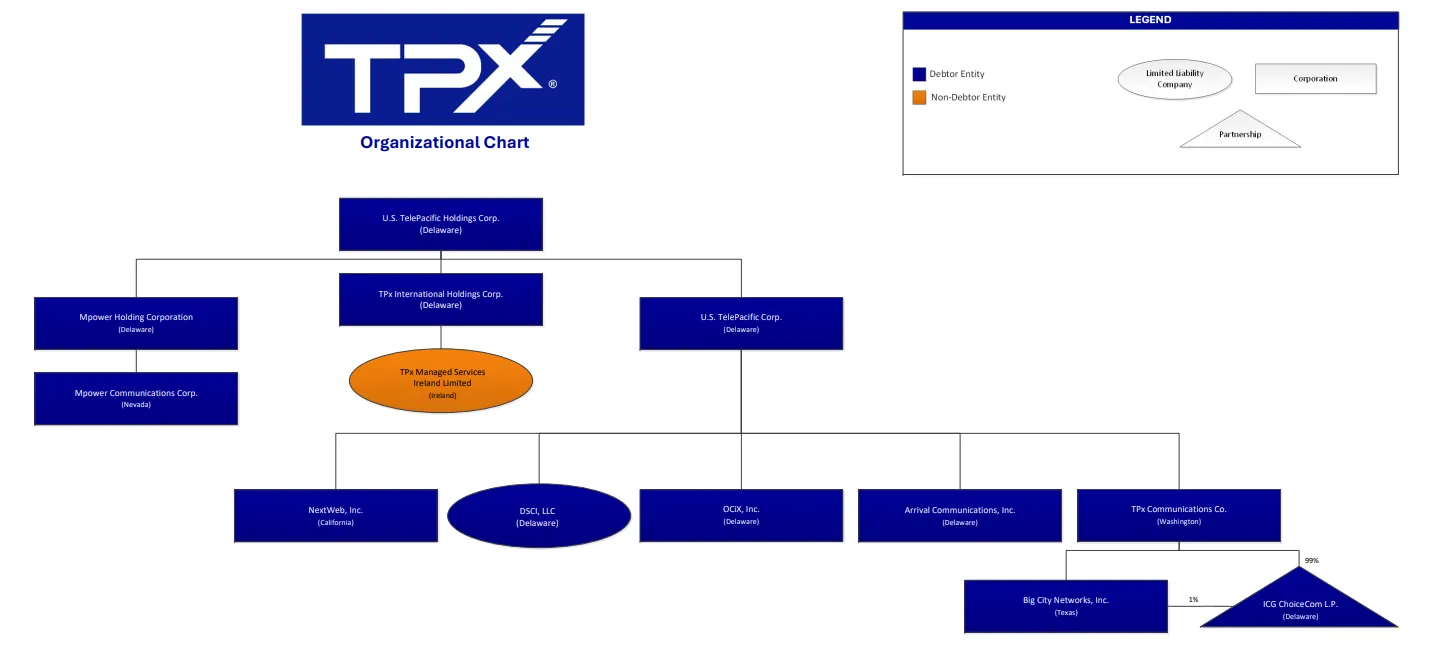
The company’s Form 204 list of unsecured claims, obtained by Bondoro Insights, shows that the company owes $349,408 to distributor ScanSource and unified communications platform Broadsoft related to Cisco Webex. It is the largest non-insider unsecured claim outside of landlord payments. Other creditors include data center landlords, outsourcing firms, telecom carriers and IT vendors.