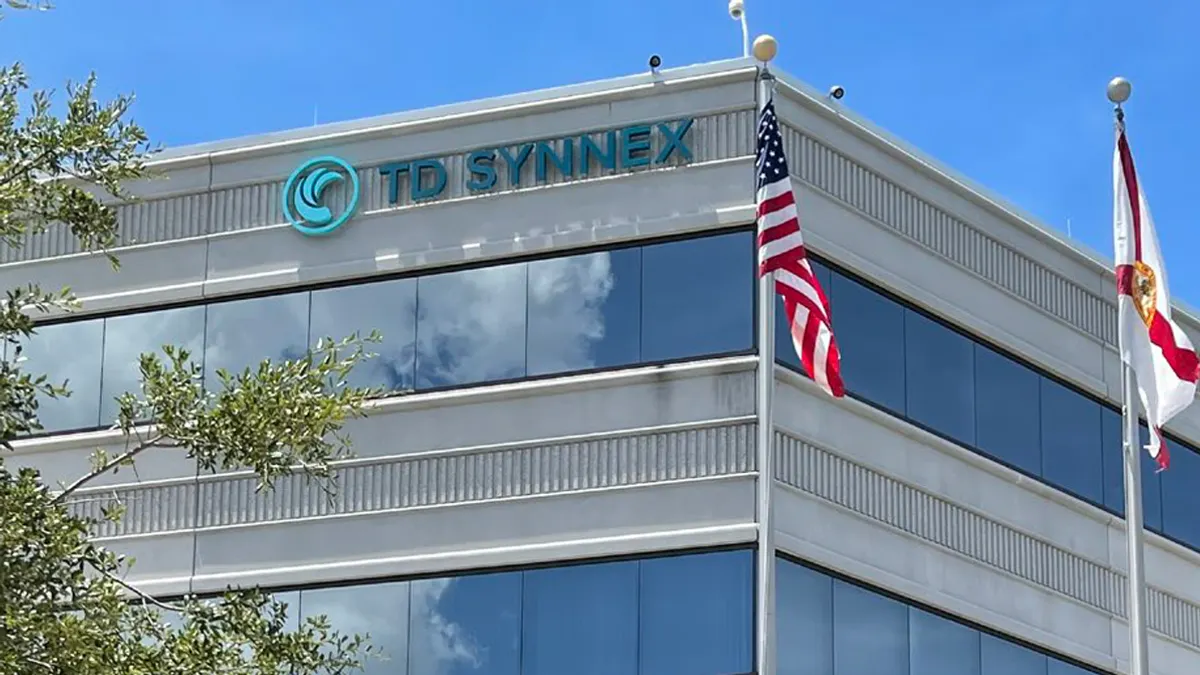
As AI adoption reshapes partner ecosystems, the channel’s largest distributor is anticipating an industrywide pivot to hardware. TD Synnex has thrived in a challenging environment for big tech, weathering the threat of tariffs and subsequent shortage of memory and storage chips.
The company reported more than $62.5 billion in revenue in its 2025 fiscal year, ended Nov. 30. Now, as AI vendors shift from subscription services to per-token billing, TD Synnex CEO Patrick Zammid senses a shift to on-premises infrastructure.
“I'm at the point where I'm saying hardware could become sexy again,” Zammit told Channel Dive, pointing to rising token costs in cloud and SaaS applications. “AI is becoming a threat for software and an opportunity for hardware. Companies are seeing an explosion in their AI costs. The best way to mitigate that is on-premises infrastructure.”
TD Synnex has successfully navigated the chip crisis so far. Its quarterly revenues benefited from PC price hikes and increases in server and networking gear costs during the first months of the year, driving its revenue to record levels during the three months ended Feb. 28.
“IT is a complex industry,” Zammit said. “You have the shortages, which could have a negative impact on unit sales, because you can't get your products. You have a positive impact on average selling prices. And you also have the risk that if ASPs increase too much, unit sales go down because customers don't want to buy at the [elevated] price.”
As analysts forecasted component shortages through the end of 2027, Zammit detected a potential windfall for the distributor and its channel partners.
However, expanding in-house data centers, colocation capacity and edge-based device capabilities requires capital investments — a tall ask when procurement costs are a moving target. To help soften the blow, some providers have turned to a time-tested tactic: warehousing.
CBTS, a Cincinnati-based managed service provider and value-added reseller, started stockpiling hardware in May to buy customers time to approve deals before prices shot up.
TD Synnex began boosting its inventory investments late last year.
“We bought PCs, servers, you name it, beginning in November and we’re continuing to do that.” Zammit said. “Price increases are a nightmare and this one of the worst we’ve seen. Vendors had to react rapidly, and resellers were quoting prices that basically weren’t valid anymore.”
Mixed market signals
The turmoil triggered by chip shortages has driven buyers in two different directions, according to a recent report by Westcon-Comstor. The distributor surveyed more than 100 members of its partner community. More than half of respondents said customers had pulled forward hardware purchases, while nearly one-quarter reported procurement delays and cancellations.
IT services providers said they were helping clients delay hardware refreshes by optimizing storage to reduce random access memory needs and moving workloads to managed services. Nearly half of respondents expressed a willingness to switch vendors.
TD Synnex is banking on an expansive portfolio of vendor products to buoy its business.
“We made a bet years ago that we wanted to be an end-to-end distributor,” Zammit said. “Our resellers need to deliver business outcomes, so all of the technologies are important. Having a diversified portfolio paid off.”
The company has maintained and expanded key vendor relationships while the distribution channel consolidates. Major providers, including Dell, Microsoft and Broadcom with its VMware acquisition, have trimmed their partner ranks in favor of large distributors with a global reach.
“We've seen many vendors rethinking their go-to market, going with fewer direct resellers, fewer distributors and clearly favoring global relationships,” Zammit said, noting a recent move by Dell to drop Arrow Electronics from its distribution ranks.
In May, HPE followed suit, handing the bulk of its distribution channel over to two global providers: TD Synnex and Ingram Micro. Arrow remains an HPE distributor in the Americas and EMEA.
“We’re building a simpler, more scalable model that supports long-term success for our partners and customers,” Simon Ewington, SVP of channel and partner Ecosystem at HPE, said in a press release. HPE distribution will be augmented by a mix of regional and specialist distributors, Ewington added.
“This is a trend,” Zammit said “It’s not just HPE. You're going to see this from more vendors.”
Clarification: This story has been updated with details about Arrow Electronics’ HPE partnership.