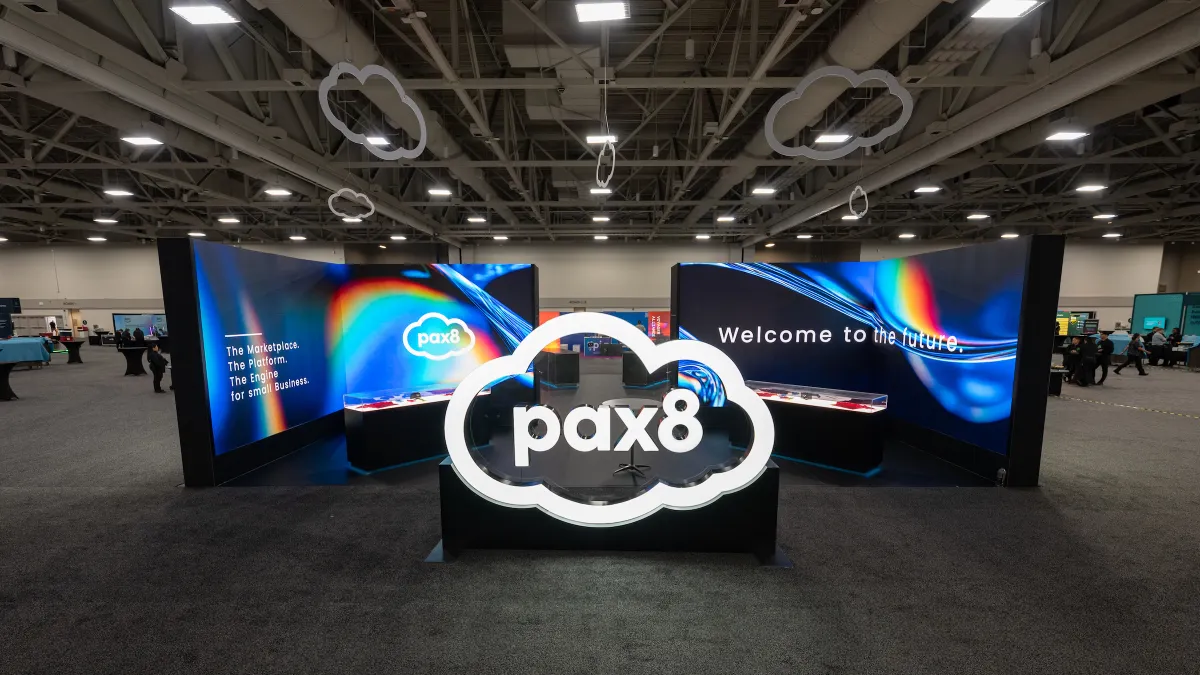
As Big Tech continues to pour billions a day into large language model training and infrastructure, the channel is still fishing around for a practical way to charge for the fruits of that spending. Pax8 has set its sights on a solution.
The cloud-based IT marketplace is building token-tracking capabilities into its MSP operations platform and working with Microsoft to deliver a multi-tenant control panel for the Copilot AI assistant, Craig Donovan, the company’s COO, told Channel Dive Thursday, after the annual Pax8 Beyond conference in Salt Lake City.
“Usage is probably going to be the predominant monetization strategy in the agentic world, but there's no good way for a partner to actually see the usage on anything they build,” Donovan said.
Billing for AI agents is one of several partner headaches Pax8 wants to alleviate in its platform. The company rolled out Managed Intelligence Provider and Managed Intelligence Services programs last week to beef up an agent marketplace it launched in October. In addition to simplifying billing for Microsoft 365 Copilot Business, ConnectWise Sidekick and Rewst RoboRewsty, Pax8 will offer AI assessment and consulting services and forward-deployed engineering expertise to its MSP clients. Pax8 also added a strategic operations layer to the platform to provide real-time account analytics, customer subscription updates, automated financial reporting and system integration specs.
The updates address specific MSP pain points while offering a coherent vision of the next phase of the IT services industry, according to Jessica Davis, principal analyst at Channel Dive sister company Omdia.
“Most MSPs are still early in figuring out how to package, price, govern and support agentic AI,” said Davis, who attended the Salt Lake City conference. “Pax8 is trying to give them a structured path into that market. The hard part will be execution, because building a vendor-agnostic agentic marketplace is complex. But Pax8 is putting the pieces in place and potentially paving the way for MSPs to create and sell their own agents as well.”
Pax8 is one of several vendors vying for the hearts, minds and business of the MSP. In the operations platform division, there are five big players jockeying for the pole position with professional services automation and remote monitoring and management offerings — ConnectWise, Kaseya, NinjaOne, N-able and HaloPSA. Most large distributors have also adopted platform strategies over the last two years, according to Omdia, as hyperscaler marketplaces have gained procurement traction.
The marketplace ecosystem has reshaped the channel as buying migrates to the cloud. Roughly 85% of partners route deals through TSD platforms maintained by Ingram Micro, TD Synnex, Pax8 and other large firms, Futurum Group Analyst Alex Smith noted in a March report.
Pax8 is moving beyond distribution to back-office automation and enablement with its managed intelligence model.
“This is a new form of pro serve that we’ve split into three paths,” Donovan told Channel Dive. “There are discovery services where we're standing up a team that can do a consultative effort with the end customer on behalf of a partner. We're building agent technology that we're using as part of our own consulting to help build better reports. And finally, if they truly need something custom, we're standing up build services where we create some custom workflows and products for the end customer on behalf of the partner.”
Breaking down the AI billing barrier is a tactical move that feeds a broader strategy, from an industry analyst perspective.
“Pax8 has one of the clearest visions among MSP ecosystem vendors for the next phase of the managed services business,” Davis said. “The Managed Intelligence Provider framing is not just a rebrand of the MSP model — it’s an argument that MSPs will increasingly move from managing infrastructure, subscriptions and support tickets to managing intelligent systems, agentic workflows and measurable business outcomes for SMB customers.”
The stakes are high. AI is refashioning the business of IT management along with the types of products and services on customer wish lists. MSPs are adapting internal processes as they reconfigure their offerings.
“AI will change not only what MSPs sell, but how they operate, how they price services and how they prove value to customers,” Davis said.
Amid mixed signals from customers lurks an existential threat to the industry, as AI infiltrates workflows through official and unsanctioned channels.
“Many MSPs are not yet hearing strong, explicit demand from SMB customers for AI services, but SMB customers are already experimenting with tools like ChatGPT and Claude,” Davis said.
“If MSPs do not help those customers use AI safely and strategically, AI-native service providers may enter the account first through workflow automation and agentic services, then expand into broader IT services over time,” she added. “For MSPs, the risk is not just missing a new service category — it is allowing a new class of competitor to move into the customer relationship from the AI side and eventually squeeze them in their core managed services business.”