

The managed services business is evolving as providers automate processes, beef up on security offerings and grapple with growing IT complexity. Top MSP vendors have supported the shift by integrating AI and cybersecurity into professional services automation and remote monitoring and management platforms that are raising the industry standards.
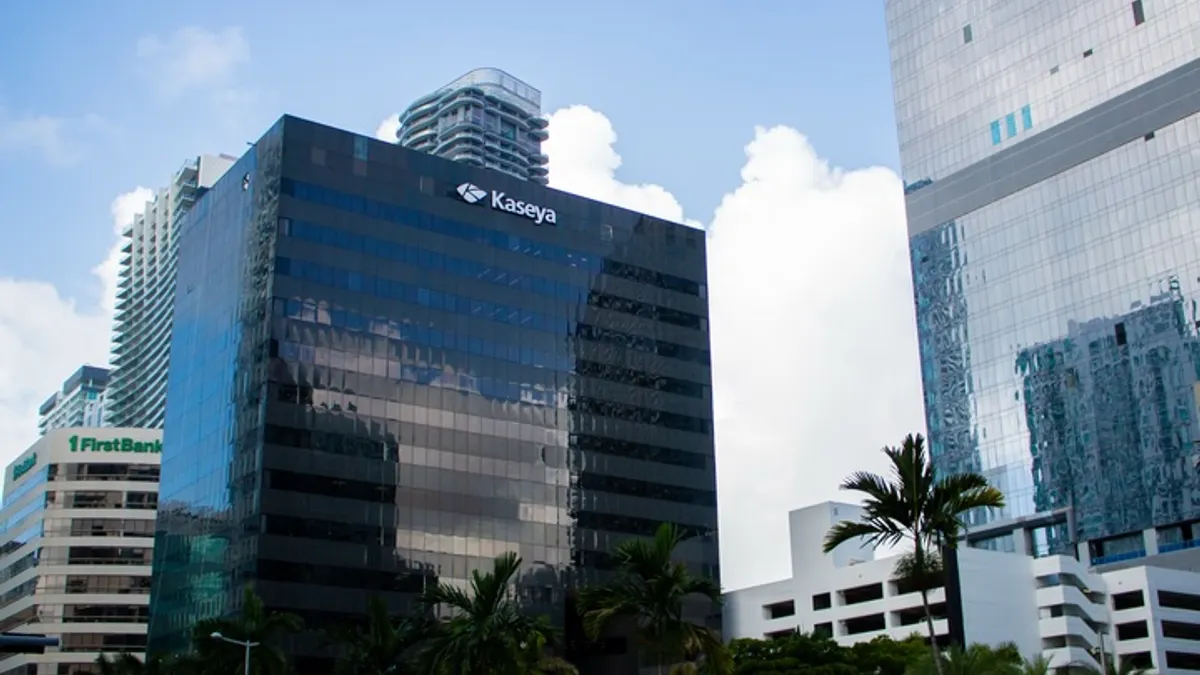
Analyst firm Omdia, a Channel Dive sister company, added Kaseya to its annual list of RMM and PSA platform leaders this year. ConnectWise, HaloPSA, N-able and NinjaOne remained at the top of the global provider matrix.
The Omdia matrix, and its associated Vendor Performance Index 2025 Overview, is more than a product or revenue scorecard, according to Omdia’s MSP practice leader Robin Ody. Vendors singled out by the firm combine “the highest levels of excellence in channel and technology capability” over a 12-month period, based on ratings from channel partners and Omdia analysts, Ody said.
Such assessments are getting more consequential as vendors add AI, managed detection and response, vulnerability management, remote access, backup and Microsoft integrations to core platforms.
The platform market is expanding. Last year, RMM and PSA vendors generated more than $20 billion in revenue, up 16.4% compared with 2024. The top five vendors held about three-quarters of the market: ConnectWise at 23.8%, Kaseya at 22.5%, NinjaOne at 14.6%, N-able at 8.4% and HaloPSA at 6%.
The threads tying these vendors together include platform consolidation, AI-enabled technician leverage and cybersecurity moving closer to RMM and PSA. Specifically, Ody wrote that ConnectWise is shifting toward a more platform-oriented approach, Kaseya has a broad portfolio moving to platform play and NinjaOne Remote “tightens platform consolidation.” Kaseya’s Digital Workforce is designed to act “like a top-tier technician,” while HaloPSA’s AI features are “reducing manual service desk triage burden,” per the analysis.
The additions mean less manual work for partners, along with security service revenues and scalability. Add-ons also raise questions about pricing, security exposure, product maturity and vendor dependence as the volume of customer operations running through fewer platforms grows.
Inside the numbers
ConnectWise remained the market share leader, with nearly $500 million in RMM/PSA revenue, according to Omdia. The provider had the highest Leadership score among Omdia’s Champions, at 71%. As part of its platform push, the company acquired AI service-desk automation provider zofiQ, launched PSA modernization powered by Asio, and rolled out ConnectWise Pro, bundling PSA, RMM, RPA, remote support, documentation, reporting and CPQ into a single contract. ConnectWise also added agentic MDR with RPA-powered security actions, moving AI deeper into incident response.
Kaseya ranked second by revenue, generating $470 million from RMM and PSA, with 14.9% growth in 2025. Ody noted Kaseya’s sizable MSP business — approximately 35,000 MSPs in its ecosystem — and its “broad portfolio of products moving to platform play.” The vendor’s Digital Workforce, which Omdia described as an agentic learning system designed to act like a “top-tier technician,” with a single view across platform components and a unified data stream, is another differentiator. Ody said INKY’s AI models will strengthen cross-platform threat correlation across endpoints, identity and email, bringing broader security coverage and more core MSP functions inside one ecosystem.
NinjaOne stands out as the growth story. Omdia said the company grew 62.7% in 2025, reaching $305 million in RMM/PSA revenue and taking the largest share among ranked vendors. Its 72% Momentum score tied HaloPSA for highest among Omdia’s Champions. NinjaOne’s recent momentum includes adding NinjaOne Remote, Microsoft integrations and MSP NXT, the latter of which Ody said “signals a deliberate investment in community and partner ecosystem infrastructure.” For partners, the changes close platform gaps, bring Microsoft-managed endpoints into a single console and build the kind of MSP community structure larger incumbents have had for years.
N-able’s Champion story is the most cybersecurity-forward. The Adlumin deal brought XDR and MDR into the company’s RMM and backup core even as, separately, N-able added vulnerability management for N-central and N-sight. For partners, that moves more security detection, response and remediation into the same consoles they already use to manage endpoints. This reduces reliance on separate security tools while making execution more critical. Omdia put N-able’s 2025 RMM/PSA revenue at $175 million, with 4.1% growth.
Finally, HaloPSA’s Champion status indicates that focus still matters. Ody described HaloPSA as “a specialist PSA vendor.” The Omdia performance index put the company at $125 million in revenue in 2025, up 36%. HaloPSA’s MCP endpoint positions the company as delivering “AI-agent-ready infrastructure at the PSA layer,” Ody noted. That means third-party AI tools can act inside Halo without custom integration work. At the same time, HaloPSA’s forecasting, ticket categorization and automated acknowledgments extend that AI push into daily service desk operations by helping partners anticipate ticket volumes, reduce manual triage and accelerate initial responses.
Works in progress
Despite commonalities, each vendor faces unique challenges.
ConnectWise’s platform transition remains incomplete, according to Omdia. The RMM/PSA leader also must manage the security burden underscored by the “significant” 2025 ScreenConnect incident, Ody wrote. Kaseya must prove that its broad platform play can deliver product depth, particularly around Datto RMM, while continuing to address partner pricing friction. And NinjaOne needs to keep building platform depth and partner ecosystem infrastructure as its growth accelerates.
N-able’s test is whether its cybersecurity platform push can translate into practical partner execution across RMM, backup, MDR and vulnerability management. Finally, HaloPSA must demonstrate whether a PSA specialist can remain central as larger rivals push broader MSP stacks.
For partners, Omdia’s matrix turns RMM/PSA vendor selection into an operating model decision. The leaders are building deeper platforms around AI, security, backup, remote access and Microsoft management. MSPs now have to ask whether those platforms reduce complexity and protect margins — or simply shift more of their business into a single vendor’s stack.