Accenture planted its flag in the midmarket last month, vowing to pursue revenue opportunities in a segment ripe for IT modernization and AI enablement services. Rather than leveraging its considerable clout among Fortune 500 companies, the consulting colossus launched a separate business unit called Accenture Edge to cater to the needs of smaller clients.
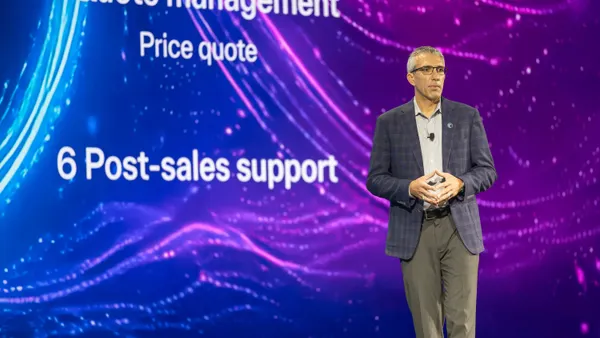
“This is not new to Accenture, but this is a new way of approaching the market through a dedicated vehicle — a dedicated brand,” Srini Subramanian, the newly appointed CEO of Accenture Edge, told Channel Dive. “When we were constructing the business, we noticed that we already had at least 10,000 midmarket clients.”
Subramanian cut his teeth in midmarket IT services. He came to Accenture via Inspirage, an Oracle ecosystem consulting services provider the firm acquired in January 2023. The division he now leads was built through similar moves that brought together more than half a dozen disparate tech providers.
“If you look at my leadership team, it’s made up of seasoned entrepreneurs who know how to work in this market, how to navigate the challenges, how to work with ecosystem partners,” Subramanian said.
Subramanian pointed to several key acquisitions in addition to Inspirage that laid the groundwork for Accenture Edge:
- NeuraFlash, a Salesforce and generative AI consulting firm acquired in September 2025.
- Retail technology services firm Logic, acquired in August 2024.
- Procurement services firm Insight Sourcing, acquired in February 2024.
- Cloud and managed service provider Navisite, acquired in January 2024.
- Imaginea, a platform engineering firm acquired in March 2021.
M&A is integral to the Accenture business model. The company is the most acquisitive partner in North America, according to Omdia, a Channel Dive sister company. On the same day Accenture launched the midmarket business, it committed $4.2 billion into a trio of cybersecurity acquisitions.
The company, which reported nearly $70 billion in revenue split almost evenly between consulting and managed services in its 2025 fiscal year, expects to invest roughly $9 billion into acquisitions this fiscal year, CEO Julie Sweet said during a June earnings call.
Building from within
Midmarket acquisitions fed the Accenture Edge. Subramanian expects the unit’s combined midmarket experience to open doors at companies that previously wouldn’t have had Accenture on their radar — or in their budgets.
“In the past, Accenture's model was that we got absorbed into the broader enterprise business,” Subramanian said. “Now, with this dedicated motion, we are being asked to operate like we used to, as independent, entrepreneurial companies.”
Accenture’s existing midmarket clients can choose to work with the Accenture Edge or remain with their current setup. The Edge team will share staffing with its parent company while building out its staff.
The Accenture Edge portfolio will be tailored to small and midsize enterprises, a growing segment where integrated platforms are the preferred IT solution.
“The platform play is allowing Accenture to access a market that did not make fiscal sense for them 24 to 36 months ago,” Peter Bryant, Omdia North American channel analyst and practice leader, told Channel Dive. “The traditional time-and-materials models that the likes of Accenture traditionally leveraged made them frankly unaffordable to the midmarket. What we have with platforms like Accenture Edge is a sustainable way to enter this market.”
The company is looking at a $240 billion opportunity among companies with $300 million to $3 billion in annual revenue, Sweet said during the earnings call.
Omdia estimates that small and midsize enterprises constitute nearly 40% of a global IT market. More than three-quarters of small-to-midsize enterprise technology spending goes through the channel, Bryant said.
AI acceleration
The race to deploy AI in search of efficiency gains has spilled over from enterprises to mid-level businesses. As with their larger peers, SMEs have a lot of work to do if they want to see returns on AI investments.
“If you look at the digital core — ERP backbone of these companies — it will require refreshing before it can take on the more advanced AI capabilities,” Subramanian. “Can you work with older ERP and platforms? Yes, but it's not ideal. Some of it has to be modernized, which means that the spend expected for these midmarket companies is huge. We already have the platform, we already have the acquisitions and we already know how to do this, so leaving that opportunity on the table does not make any sense.”
There’s an entire industry gunning for AI revenues and the investments it will require to modernize SME infrastructure through services and forward-deployed engineering teams.
“As direct motions via FDEs become more commonplace there will be increasing need across the largest GSI and service providers to widen their addressable market, and the only way to do that is to drop down in a sustainable way,” Bryant said. “The private equity firms have had the same idea but have been attacking it from the bottom up, collecting multiple MSPs and consulting firms and packaging them up together to reach upwards with broader range. All in all, what we are seeing is the largest amount of competition in this upper midmarket in quite a while.”
One of the keys to unlocking the midmarket is meeting them where they are, Subramanian said. He’s counting on his team’s understanding of the SME mindset to provide an edge.
“For a $700 million company that's focused on one or two critical products, a supply chain planning project may be very strategic,” said Subramanian. “What they want is an account executive who understands the business working with an ecosystem partner to bring that solution to life. They don’t want to conduct a major bake off between five different platforms in an elaborate search for a new solution.”
The companies Subramanian has in mind aren’t keen on administrative red tape.
“They want to interact with the CEO of the business,” he said. “They want to shake hands and say, ‘Deal. Let's go do it.’”