

The rapidly evolving AI economy has partners guessing how to position their offerings. Industry analysts aren’t certain either, as infrastructure buildouts boost hardware sales and AI adoption hurdles leave enterprises hungry for trusted guidance.
Hardware providers have been the biggest beneficiaries of the AI boom, as Big Tech pours tens of billions of dollars into chips, servers and data center capacity, driving growth across the supply chain.
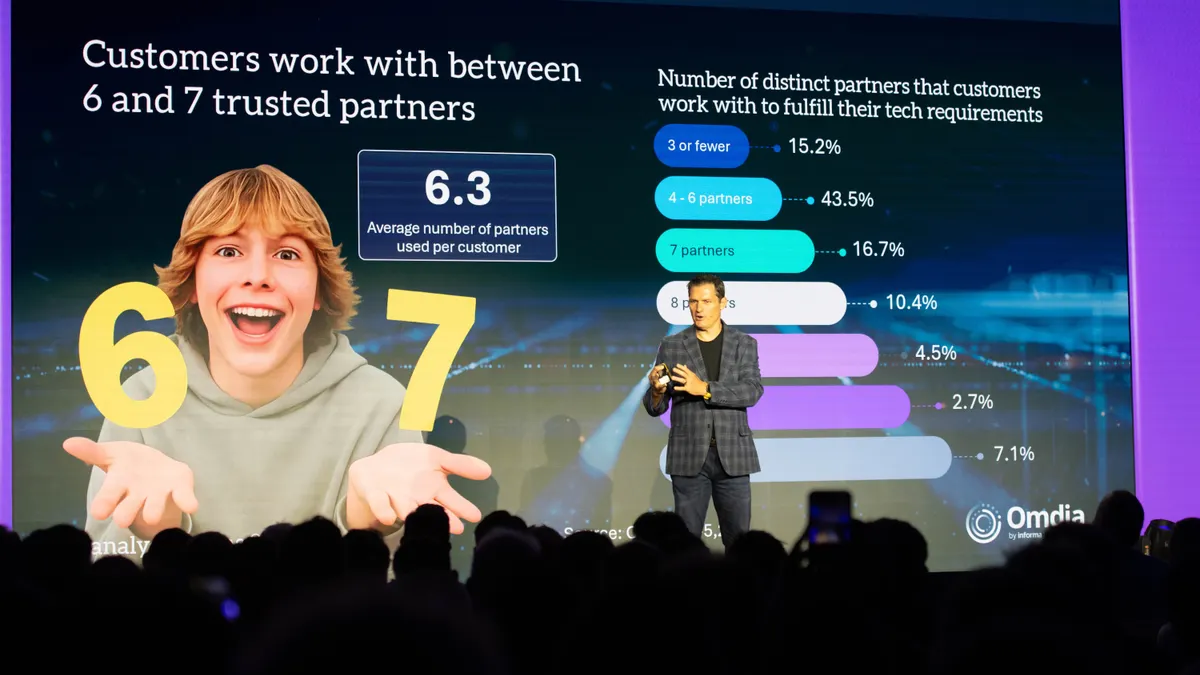
“For 30 years, you’ve gone to conferences and people have told you the future of the channel is software and services,” Canapii Co-founder and former Canalys CEO Steve Brazier said during a keynote at the Canalys Forum EMEA in Barcelona earlier this month. “They’ve been wrong for 30 years, and they continue to be wrong because the companies making their money today are involved in hardware.”
Hardware prices have been rising since late last year, according to Omdia, a Channel Dive sister company that bought Canalys. Brazier expects that trend to continue for at least another 12 months, potentially through 2028, as AI investment places further pressure on semiconductor supplies.
“Stock up your warehouses now,” Brazier advised partners.
Differing views
Brazier expressed skepticism about generic AI consulting practices, warning that most would fail.
Omdia Chief Analyst Jay McBain offered a different perspective, challenging the notion that partners should build long-term strategies around hardware.
“For the first time in 19 years, I’m going to disagree with the opening keynote,” McBain said.
While hardware presents a near-term opportunity, McBain said reselling hardware was not a sustainable three-to-five-year strategy.
“It’s a point-in-time opportunity,” he said.
Instead, McBain pointed to AI-related services, which Omdia forecasts will grow at a compound annual rate of 32.5%, reaching $347 billion by 2031.
Splitting the difference
The current market can support hardware resale and AI services, according to Josh Perkins, VP of emerging technologies at infrastructure and managed service provider Ahead.
“Steve and Jay are both right, just on different timelines,” Perkins said. “Hardware is where the money is moving today. Services are where partners hold onto it.”
Investments in AI infrastructure will dwarf spending on AI services this year, according to Gartner’s latest market forecast. The analyst firm expects AI infrastructure spending to increase by more than 50% year over year to nearly $1.5 trillion, while the AI services market gets a healthy 33% bump to $5.76 billion.
Perkins acknowledged that infrastructure is capturing much of the immediate AI spending, but added that customers need more than compute capacity to make their investments successful.
“A GPU in a rack isn’t an AI strategy, and neither is a pilot with no platform underneath it,” he said.
The partner opportunity extends from designing and operating AI infrastructure to developing workloads and redesigning business processes around them.
Neil Anderson, VP of cloud, infrastructure and AI solutions at World Wide Technology, agreed that infrastructure represents a significant revenue opportunity. However, the size of infrastructure deals can paper over significant commercial challenges.
“Large infrastructure deals can come with considerable margin pressure, which can create friction across the partner ecosystem,” Anderson said. “Services generally offer higher margins for partners, but success depends on having the right skillsets and experience.”
WWT expects the infrastructure investment cycle to continue, particularly as neocloud providers expand and enterprises begin building private AI environments.
Anderson said the global systems integrator, reseller and service provider is seeing projects already underway alongside a multiyear pipeline of investment, with private AI data centers still representing a largely untapped market.
Mixed market signals
While demand for hardware remains strong, resellers and distributors were cautious about stockpiling components.
“Lock in capacity and configurations for workloads you already have,” Perkins said “Don’t buy ahead without a deployment plan. The shortages are real, but a pile of unused hardware doesn’t solve them.”
Rene Klein, EVP of distributor Westcon-Comstor Europe, said hardware volatility had affected purchasing behavior.
Research from the distributor found that 52% of partners have accelerated hardware purchases because of supply pressures and 23% have delayed or canceled purchases. Another 29% have switched vendors or platforms in response to availability constraints.
“Blanket advice to build inventory should be treated with caution,” Klein warned.
Decisions should reflect confirmed customer demand, lead times and the financial exposure associated with holding stock, he added.
Perkins also took a measured stance on generic AI consulting, particularly on providers that deliver strategies or pilots without taking responsibility for production deployments. The lasting opportunity rests in combining infrastructure engineering, data services, security and managed operations with AI workload development and business process transformation.
“The ones that struggle hand over a roadmap or a pilot and walk away before anything goes live,” he said.