The annual Channel Partners Conference & Expo was buzzing with AI anecdotes last week in Las Vegas. Amid the tales of coding heroics, productivity breakthroughs and recurring revenue streams, partners grappled with the reality of stubborn IT readiness gaps undercutting adoption efforts.
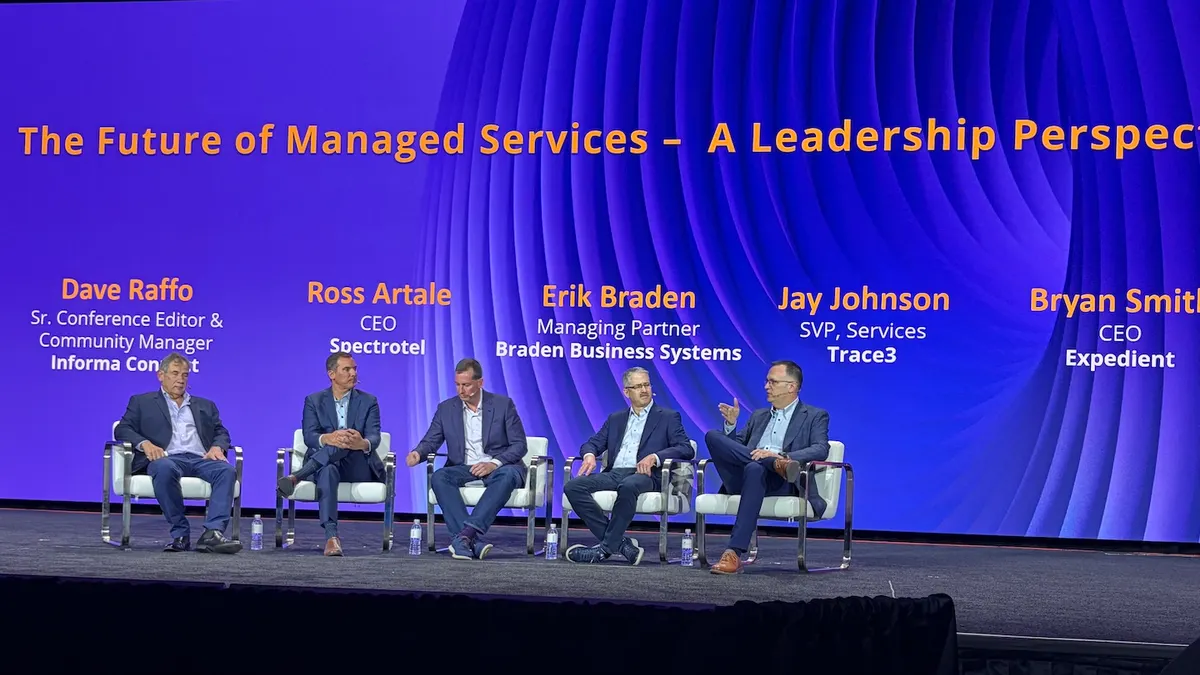
“Seven out of the 10 conversations we're having with the C-suite right now are definitely around the AI paradigm — and their struggle with it,” Eric Braden, managing partner at Braden Business Systems, said, during a panel kicking off the event’s MSP Summit. “All the things required to run a good AI implementation, adoption and outcome strategy, main-street businesses cannot do on their own. We have a big opportunity to be their quarterback.”
IT services remain the largest single slice of global IT spending, accounting for $1.7 billion of the more than $5.5 trillion market last year, according to Gartner. This year, the segment is expected to command 30% of global spending as the market grows 10.8% to $6.15 trillion, the analyst firm said in February. Demand for AI services will grow by roughly 40% to nearly $600 million as adoption of the technology spreads.
“The board conversation with the CEO starts with, ‘Oh, give me some of that AI,’ and then it's on their team to implement,” Expedient CEO Bryan Smith said. “The biggest challenge we see is the adoption and usage of it, because just by rolling something out, when you're not enabling a team, it just doesn't really work very well.”
Top-down demand is speeding up deals. At Expedient, an MSP focusing on cloud, data center and resiliency services, the average AI service deal takes just one to two months from initial conversation to close, according to Smith.
Despite executive eagerness, partners are confronting deep-rooted deployment obstacles that touch core technologies, much of which is familiar ground for the MSP industry.
“We've really framed it as what we call the trilemma,” Smith said. “You have 80% of companies that need to redo their hardware and redo their infrastructure to really leverage AI correctly. You have about 70% of companies that are looking to reduce their hyperscaler spending, and you have nearly 100% of companies that are reevaluating their hypervisor strategy. All those things come together in one decision, because they all really interplay with each other.”
Expedient has targeted all three challenges, most recently rolling out a bridge program to provide VMware continuity and migration services to organizations reassessing their hypervisor in the wake of Broadcom’s acquisition of the virtualization software vendor. The company deployed an AI governance platform and outcomes team in February.
“At the core of our business is security technologies together to simplify implementation and operations,” said Smith. “AI is no different.”
The consulting function — acting as a trusted advisor — has been a key to capturing business for Spectrotel, a firm that manages network services for enterprise and mid-market organizations.
“I think every CIO is having conversations with their board and their CEO on how to accelerate learning and drive efficiency through their business, so sort of a little bit of the Wild West,” Spectrotel CEO Ross Artale said. “Our view is that they’re really looking for analysts and thought leaders to providing business context for implementations.”
The AI race has also stoked demand for network upgrades, as inferencing workloads mount.
“Connectivity really enables the proliferation of cloud and AI,” Artale said. “It's the ultimate enabler.”