



Dive Brief:
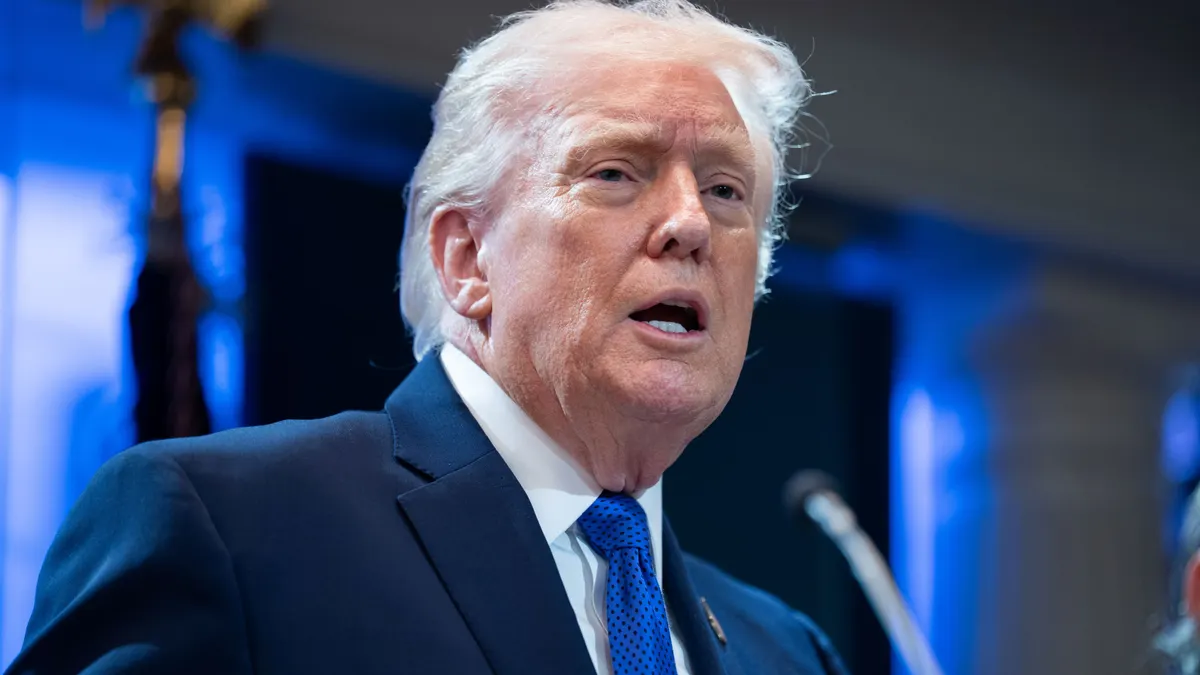
- President Donald Trump on Friday issued a national policy framework for AI that stresses the importance of a federal approach to regulation while outlining scenarios when federal law should not preempt state law, giving businesses insight into how Congress could legislate on AI issues.
- The framework, made up of six pillars, emphasizes the role of courts in resolving issues around copyright infringement while directing Congress to prevent censorship and streamline federal permitting for AI infrastructure. Court settlements and legal outcomes will ultimately provide guidance on use of copyrighted material for AI model training, according to Forrester Principal Analyst Alla Valente.
- “This is a wish list for Congress of what within AI they can vote on, rules they can support, and rules they can’t,” Valente told CIO Dive. “For businesses, monitor a lot of the court cases, whether there are settlements or trials about IP. For the moment, Trump has designated that courts are going to take the lead on deciding the copyright violation issues.”
Dive Insight:
The White House is calling on Congress to turn the Trump administration’s proposed national AI framework into legislation that preempts “conflicting” state AI laws, reflecting an ongoing battle between lawmakers trying to slow AI’s reach and tech companies striving for a rapid pace of innovation.
The growing patchwork of state legislation has become a contentious business issue, leading companies such as Meta to launch lobbying efforts in support of political candidates that align with their views on AI oversight. Recently, a political action committee against AI regulation spent millions opposing a local New York congressional candidate ahead of the 2026 midterm elections, the Wall Street Journal reported.
Trump signed an executive order in December challenging state AI laws, which included a call for the national policy framework for AI that was released Friday.
While the policy framework addresses preempting “cumbersome state AI laws,” it instructs Congress to leave a state’s traditional police powers to enforce generally applicable laws that protect children and senior citizens, prevent fraud and protect consumers. States should keep zoning authority over placement of AI infrastructure and authority over a state’s own use of AI, according to the policy document.
It also carves out areas where Congress should build on existing legislation, such as extending child privacy protections that limit data collection and targeting advertising to AI systems.
“This is the White House’s way of saying that, ‘We’re not being unreasonable, we don’t want citizens to experience harm,’” Valente said. “‘At the same time, we don’t want to make this overly burdensome for companies. This is a little something for everyone.’”
Rep. Mike Johnson (R-La.), speaker of the U.S. House of Representatives, shared a joint statement with other representatives on social media platform X committing to act on Trump’s AI policy framework and “working across the aisle to enact a national framework that unleashes the full potential of AI, cements the U.S. as the global leader, and provides important protections for American families.”
A few days before Trump unveiled his AI policy framework, Sen. Marsha Blackburn (R-Tenn.) on Wednesday introduced a draft of the Trump America AI Act, which focuses on similar elements outlined in the framework such as protecting children. The draft bill proposes establishing requirements for companies providing AI chatbots and companion services, for example.
The draft bill differs from Trump’s policy framework by proposing a requirement that companies and federal agencies release reports on AI-related job effects, including layoffs. It also proposes enabling the U.S. attorney general, state attorneys general and private actors to file lawsuits against AI developers for harms caused by systems and platforms.