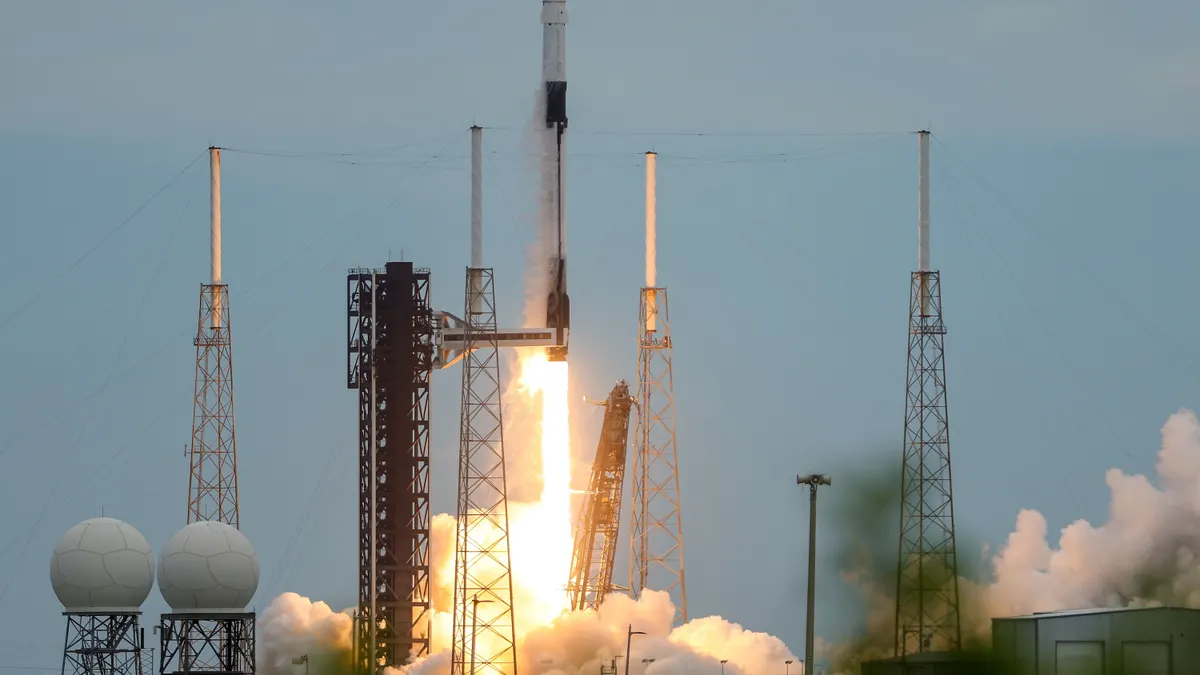
The space industry has diversified as satellite and launch programs move to the private sector. TD Synnex wants to outfit its partners with the tools and technology to capitalize on the opportunity.
Last month, the technology distribution giant launched an initiative to build a channel program around the space economy. The company is leaning on space industry consulting firm the Artemis Group, launch infrastructure vendor All Points, workforce development provider Nova Space and Florida Institute of Technology to contribute training and guidance as partners move into a historically difficult market.
“When the civil and defense contractor community dominated this space, you had a really limited playing field,” Eddie Franklin, SVP of vertical markets and leader of the space tech initiative at TD Synnex, told Channel Dive. “It was almost a gated community of contractors. You might have had subcontractors that did work on behalf of the primes, but the opportunity for commercialization was minimal.”
TD Synnex isn’t starting from scratch. The channel already has a foothold in the industry, according to research firm and Channel Dive sister company Omdia.
Last year, channel partners earned more than $23 billion from space-related technology consulting, systems integration, resale and managed services. By 2035, Omdia expects the channel share of space industry spend to approach $56 billion.
NASA alone awarded channel partners $1.3 billion in contract revenue in 2025. Regional systems integrators Peraton, CACI International, Barrios Technology, Booz Allen Hamilton and ASRC got the lion’s share of the federal space agency’s partner spend, but the playing field is widening as the market expands.
Managed space services
A big chunk of the current demand is for familiar, terrestrial-based partner services, Omdia Research Manager Noah Dantes explained during a keynote at the November Canalys Forum Americas in Scottsdale, Arizona.
“Today, the market is very much driven by data and connectivity,” he said, noting that managed service providers and managed security service providers have a big role to play in the ground infrastructure that supports satellite deployments.
“Most satellite systems today were not designed to withstand modern threat environments,” Dantes said. “This is where MSPs and MSSPs play a critical role in securing the space asset, both at the ground level and out in orbit.”
As the market matures, Omdia envisions roles for partners in more futuristic scenarios, including lunar bases, orbital data centers and space-based energy grids, Dantes added.
A modernization mission
Amazon, Google and SpaceX are mapping out the big-picture commercial opportunity with satellite deployments and other space activities. But the broader industry could use a tech overhaul, according to Bill Weber, who joined the Artemis Group as a senior advisor in March.
“The near-term opportunity is just like every other industry,” said Weber, who previously served as CEO of launch technology firm Firefly Aerospace. “We have to modernize infrastructures that are woefully inadequate. It's buildings, launch complexes, warehouses, manufacturing capacity. And then, as space companies are comfortable using the reseller network for that, as we think about putting compute and technology in orbit, it'll be a natural adjacent fit.”
Weber’s firm will provide TD Synnex resellers with strategic market intelligence, while All Points keeps partners updated on satellite manufacturing and launch schedules. Florida Tech will serve as a talent source as partners grow their industry footprint and Nova Space has developed channel-specific certifications in civil, national security and commercial space technologies for the initiative.
“We're not trying to teach the channel to be rocket scientists or satellite manufacturers, but we want them to know how space operates,” Franklin said. “We want them to be confident and able to talk to these customers about the missions that they're supporting and then understand how to apply the right IT solution to that.”
TD Synnex has hundreds of partners currently selling into the space economy, according to Franklin. A lot of that work runs parallel to their traditional lines of business, from PC fleet management to larger infrastructure installations.
“Every command-and-control facility or antenna station has got tons of large format displays and communications equipment that we're selling into many other industries,” Franklin said. “If you’re a partner who’s managing desktop fleets or fleets for a sales force, a school district, a municipal government or a corporate entity, it’s the same in the space industry.”
The IT stack TD Synnex is eying is vast and aging, Franklin added. “It's only going to get worse, which is good for us because they need a lot of stuff,” he said.