Partners remain largely cut off from the torrent of hyperscaler dollars pouring into AI data centers. Yet, as the AI building boom spreads beyond the technology sector, demand for infrastructure upgrades has reached the channel.
“The channel doesn't do a ton of fulfillment on the hyperscale side,” Mike Crosby, executive director at Circana, said earlier this month at the Channel Partners Conference & Expo in Las Vegas.
More than two-thirds of the $243 billion U.S. data center product and services revenue is generated through direct sales, with hyperscaler spending accounting for nearly half, according to Crosby. That leaves roughly $78 billion on the table, as partner opportunities bubble up across multitudes of small and midsize businesses eager for guidance as they grapple with governance and other AI deployment issues.
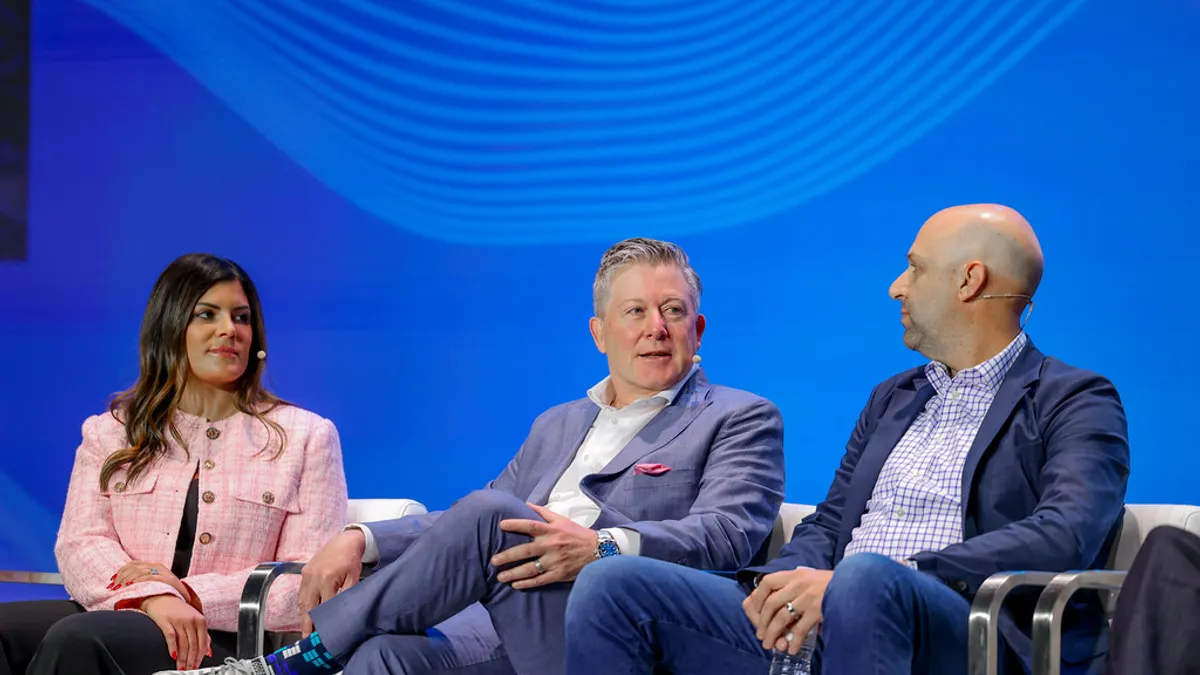
“Most small and most midmarket companies are not building models,” Juan Orlandini, CTO of North America at global solutions integrator Insight Enterprises, said during a panel moderated by Crosby. “They don't need huge clusters of Nvidia hardware and all these accelerators. They just need a place to be able to consume AI or maybe onesie-twosie specialized small language models.”
Insight launched an AI services suite along with the proprietary AI project management platform, Prism, in November as part of a broader AI push that included the $212 million acquisition of consulting firm Inspire11. More recently, the company drafted Accenture veteran Jack Azagury to succeed its retiring President and CEO Joyce Mullen, effective April 13.
Orlandini said clients are seeking “an opinion stance and an outcome that you can help them drive … If you can help your clients through that adoption cycle and become a virtual CIO or one of those kinds of things that can help them do the spin navigation, it'll be a huge win for you, huge win for the clients, and it'll add up to a significant amount of profit and margin.”
Security is crucial, he added.
“The level of AI consumption by bad actors far outpaces what even large enterprises are doing,” he said. “Small and midmarket organizations just do not have the time, they don't have the expertise, and they don't even understand the problem space.”
Just say ‘no’
AI security has emerged as one of the tougher nuts to crack as businesses reassess infrastructure needs and gear up for broad adoption. Safety concerns have prompted many organizations to revisit hybrid-cloud strategies to shore up IT resilience and bolster defenses.
An evolving situation calls for caution before action, Align Technologies President of Managed Services Vinod Paul, said during the panel.
“We say to our client base, ‘Stop. Let’s start and get you read from a data governance standpoint. We're going to hold your hand, hold your hand and set you up for a roadmap of successful deployment of AI and keeping you secure, because some of the policy hasn't even caught up to what the world is producing now,’” Paul said.
A hybrid cloud rethink is an opportunity for Align and other MSPs that have on-premises infrastructure expertise. As smaller, task-specific AI models and agents roll out, servers and networks are adapting, according to Forrester. The analyst firm expects private-cloud AI deployments to expand this year, fueled by cost and security concerns.
“There is a vast misallocation of capital occurring at the moment — too much money funding public models while private models are underfunded,” Forrester CEO George Colony said in a March blog post. “Smart investment should be seeking out companies that are sitting on big piles of data that will become more valuable once converted to work in a private model.”
MSPs should be urging clients to apply the brakes before racing ahead with AI initiatives.
“There are tons of platforms out there and tons of new products,” Paul said. “What we want to do with our clients is help them say ‘no’ to the wrong paths.”
At the same time, partners should be hitting the accelerator on internal AI adoption to identify pitfalls and chart routes around common roadblocks.
Insight took a “client zero” approach to establishing an AI practice, according to Orlandini.
“We built internal tools and internal processes and internal security controls and mechanisms so we could learn what this landscape really looked at before we brought it to our customers,” he said. “That's going to be a huge value that you can bring to them, because it is so ridiculously bad out there right now.”
Align is looking to cut the time it takes to complete IT service processes down by a factor of five, according to Paul.
“Labor is the killer of profit,” Paul said. “I won't sacrifice client service, but I think that AI is going to give us a tool that's like no other.”