

As vendors add AI capabilities to managed service provider software, MSPs are bullish on the tools, but wary of the costs.
One of the larger providers in the space, Kaseya, has been managing expectations since the eagerly anticipated launch of its agentic IT management platform last month. The offering is built on a data engine that many MSPs welcomed, even though the cost remains an open question.
“Are people already buying Kaseya Intelligence? The answer is yes, in different forms,” Kaseya CPO Jim Lippie told Channel Dive.
The professional services automation platform provider unveiled the platform on April 28 at its annual conference, contrasting its homegrown build against “bolt-on” agentic tools acquired by the likes of ConnectWise. Key to the announcement was a set of AI agents that route service desk tickets. Although MSP luminaries have called ticketing a clear use case for automation and some of the largest MSP roll-up platforms have built their own tools, Lippie said only 5% to 10% of Kaseya customers used the feature.
“I think there's a lot of MSPs out there that have been waiting for what we released, which essentially is native inside of their PSA,” he said.
Kaseya MSPs agree with the philosophy.
“I like what they are thinking about with building a unified data layer and a unified API layer on top of this,” KeyStone Solutions CEO Preston West said. “I think that's the only way that these AI systems will truly be able to understand context and correlate the information in a way that's truly useful within the platform.”
West was already bought into Kaseya’s product roadmap. KeyStone subscribes to the “ultimate” tier of Kaseya licenses and joined the beta group for its newly announced SIEM offering. The challenge now is deciphering how new capabilities will be grandfathered into existing licensing.
Kaseya has yet to disclose which capabilities will add costs or how pricing will be modeled. The company is taking a wait-and-see approach, as it analyzes the data from MSPs already signed on to the platform.
“Customers that are on certain bundles or certain products with us are leveraging Kaseya Intelligence, but right now it's bundled in from a pricing perspective, and eventually there will be some incremental fees associated with some of these products,” Lippie said.
Pricing for some categories has been established. Kaseya SIEM, for example, will be on a per-user basis, a move Kaseya Connect attendees welcomed, according to Jessica Davis, principal analyst at Channel Dive sister company Omdia.
“I think that ingestion-based SIEM has burned some companies,” Davis said.
Lippie said it was also novel because some SIEM providers charge customers per device.
“We've effectively lowered the cost of SIEM for everybody and made it attainable, because … the average employee is using more than one device,” Lippie said.
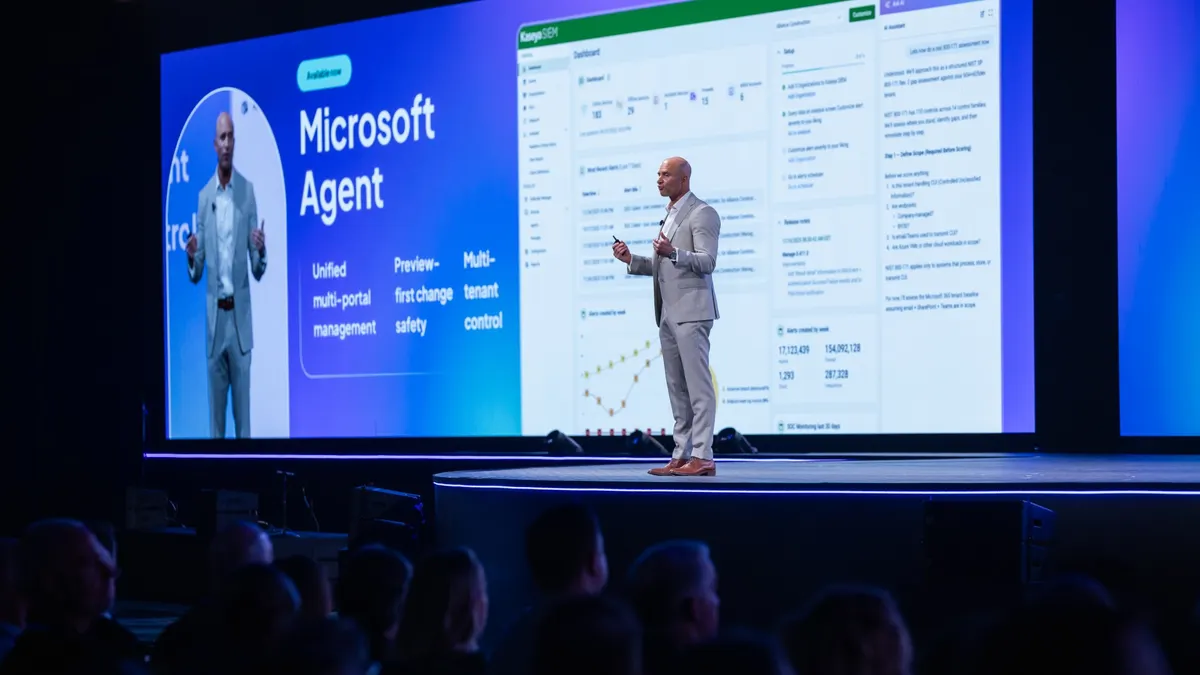
Microsoft Agent, a governance capability layered into Kaseya SIEM, is free for now but will eventually incur added costs, Lippie said.
“Why are we doing this? Because this is new, and we need to see the level of adoption and usage to come up with a fair price for both the customer and for us,” he said.
Kaseya is still mulling pricing for the ticket triaging agent. It may charge on an incremental basis or give it to a select number of MSPs for free.
“We need to really better understand the cost of goods sold, and the best way to do that is to see usage over a few months,” he said.
MSP software vendors are weighing various AI pricing options, according to Davis. Consumption-based and outcome-based models are the talk of the town in the IT world, but aren’t an easy fit for the MSP industry.
Managed service firms are used to monthly per-user or per-device rates.
“If we move to consumption-based pricing, that's going to break that whole managed services model,” Davis said.
Most vendors realize that a disconnect exists “between the costs of consumption of AI and how AI is currently priced,” Davis added. A combination of pricing styles may be the compromise.
“If there's a mismatch between the way MSP vendors are pricing versus how MSPs are pricing, MSPs need to be super careful, because they could get left holding a lot of cost without pricing appropriately to the end users,” she said.