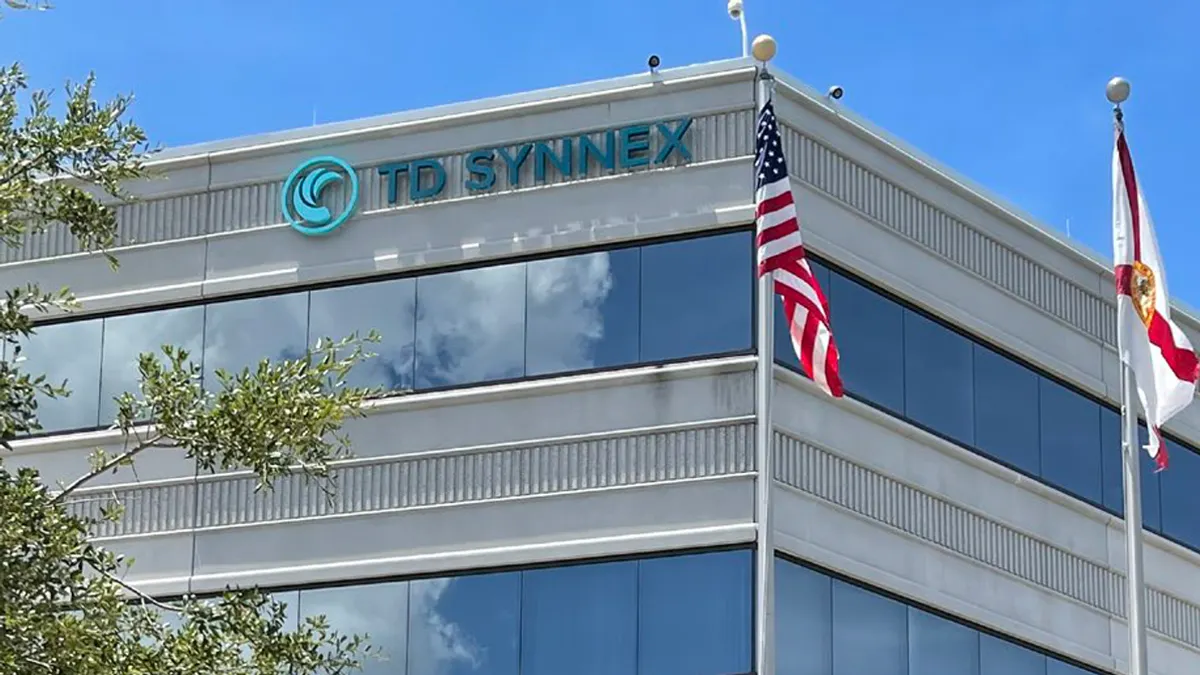



AT&T is looking to extend its lead over rival carriers with an aggressive push in hiring and APIs and a customized strategy for its largest agent partners, Jush Danielson, AT&T Channel Chief, Alliance TSD and ACC Business, told Channel Dive.
Company executives believe a renewed focus on indirect sales will propel AT&T as the U.S. telecom industry sheds headcount.
Danielson is 14 months into her tenure leading AT&T’s sales through technology service distributors and technology advisors — a route to market that has gradually grown in its share of the company’s revenue over the last decade. The provider previously focused its channel efforts on a group of partners that exclusively sold AT&T services but in recent years has embraced the vendor-agnostic model of TSDs and TAs.
“We really believe in this distribution model of leveraging the trusted advisor — the TSD community ecosystem — in order to get to our end customers. There's no way we can do that with just our direct sales force,” Danielson said. “What I'm seeing in the marketplace is that our competitors don't seem to have that same philosophy.”
Danielson said other providers are trimming their channel teams. She didn’t name names, but Verizon’s plan to shed more than 13,000 employees has stoked concern from partners.
Danielson said her TSD-focused organization has grown by 25% in headcount, while AT&T’s back office team has grown by 69%. The roles include pre-sales, escalation and post-sale support.
While Danielson's group has grown, AT&T leads all U.S. telcos in job cuts, with more than 95K jobs slashed since 2020.
API push
Systems are just as important as headcount.
AT&T COO Jeff McElfresh admitted last year that the company wouldn’t have received a passing grade for its partner experience, due to a maze of legacy portals and billing systems.
Danielson’s team has thrown itself further into API development to ensure partners can automatically quote and order connectivity through third-party platforms like Cablefinder and Connectbase, which the TSDs embed into their own portals.
“For the last 60-90 days, we've been on a number of sprints with all of our APIs,” Danielson said. The time it takes after a TA places a customer location address in Cabledfinder to when AT&T responds has shrunk 80%, she said.
ACS Cloud Partners President Eric Asquino said AT&T had already established an API-friendly reputation, but the TSD has seen further improvements in the last year and a half.
“One of the things we really look for is accuracy and response time on getting the pricing back, helping orders and stuff like that,” said Asquino, whose company built its own software to integrate information from AT&T and other carriers. “They're totally willing to kind of roll up their sleeves and help on that stuff.”
Danielson said AT&T is currently working to make it easier for customers to qualify for fiber solutions, which typically take longer than broadband. AT&T is eyeing multi-dwelling units in particular.
The fix for fixed wireless
API integration is also key to driving sales of fixed wireless access.
Danielson vowed last year to spur FWA adoption among TSDs and TAs, which historically focus on wireline solutions like broadband, dedicated internet access and fiber. Danielson hoped TAs would increasingly tack on FWA as a secondary circuit at customer locations.
TSDs grew their sales of FWA 30% last year, but Danielson said that only scratches the surface. Much of the growth comes from select players that are leaning in, while widespread adoption is still lacking.
“The ones that get it are hitting it hard, and they're pulling in some great wins, but the majority of them still aren't dabbling in it,” she said.
The biggest challenge is that it hasn't been easy to quote, qualify and implement FWA.
“The very sophisticated word that I'm going to use is ‘clunky,’” she said. “If you're not savvy with AT&T systems and processes, it doesn't come easy.”
Historically, TAs needed to use a separate system to sell FWA, as opposed to the wireline solutions immediately accessible on their TSD platforms.
“If someone comes to me with 600 locations and I've got to find bandwidth for them, if I have to pivot my desk into a completely different process and qualify AT&T over here, but I can qualify the entire market over here, that's obviously going to put them outside the mix,” said Curt Allen, EVP of Client Advisory at Bluewave Technology Group.
Danielson said AT&T will change its process for quoting and ordering FWA by the middle of the second quarter. Allen said he’s hopeful that the updates will spur fixed wireless momentum for partners.
“We have complete, big confidence in their technology and their ability to deliver,” he said.
Managing the mega-agents
AT&T is also shifting its channel manager structure to accommodate mass TA consolidation.
TAs were historically small-staffed firms until a wave of private equity investors entered the space five years ago, fueling large platforms like Upstack, Amplix and Bluewave.
Vendors originally didn’t know how to approach these super-advisors. Some tried to manage them as they would a TSD, while others kept treating them like small agencies. Historically, TAs were small enough to fit inside a single geographic region, allowing vendors to assign a regional channel manager to them. Now the largest agencies are spread out across the country, beyond the purview of a single regional channel manager.
“It became very difficult to develop a strategy with the mega-agent when they've got all these disparate agents underneath them all over the country,” Danielson said.
In addition to increasing its regional channel managers in TA-dense areas, AT&T is giving certain “mega-agents” dedicated personnel. If the pilots go well, it will expand the model into additional partners.
Bluewave, which has completed 26 acquisitions, prefers the approach and is asking other vendors to do the same. The majority of vendors are adopting or pondering the model, Allen said.
“If you're measuring participation, we shouldn't be one check box,” Allen said. “We should be 48 check boxes. Have you gotten to all of my sellers?”
Engaging the rest of the channel
AT&T and other ILECs still have their hands in getting TAs to work with them directly.
Trust Technology Consultants is emblematic of much of the TA community, which uses aggregators such as BCN, AireSpring, and NHC to sell the big carriers. Co-owner Mack Slaughter said the TSDs have created specialized teams to press through manual processes of the biggest telcos and cablecos.
“The less I have to work with AT&T to sell AT&T, the better,” Slaughter said.