

For channel partners managing enterprise network services, here is a question that’s a sign of our times: When your customers' AI workloads start underperforming, who will they call?
That call is coming, according to Manish Mangal, president of Tech Mahindra's Americas communications business and a 27-year telecom veteran with stints at Reliance Jio, Sprint (now T-Mobile US) and Nokia. He worries that network operators and their partners aren’t ready for it.
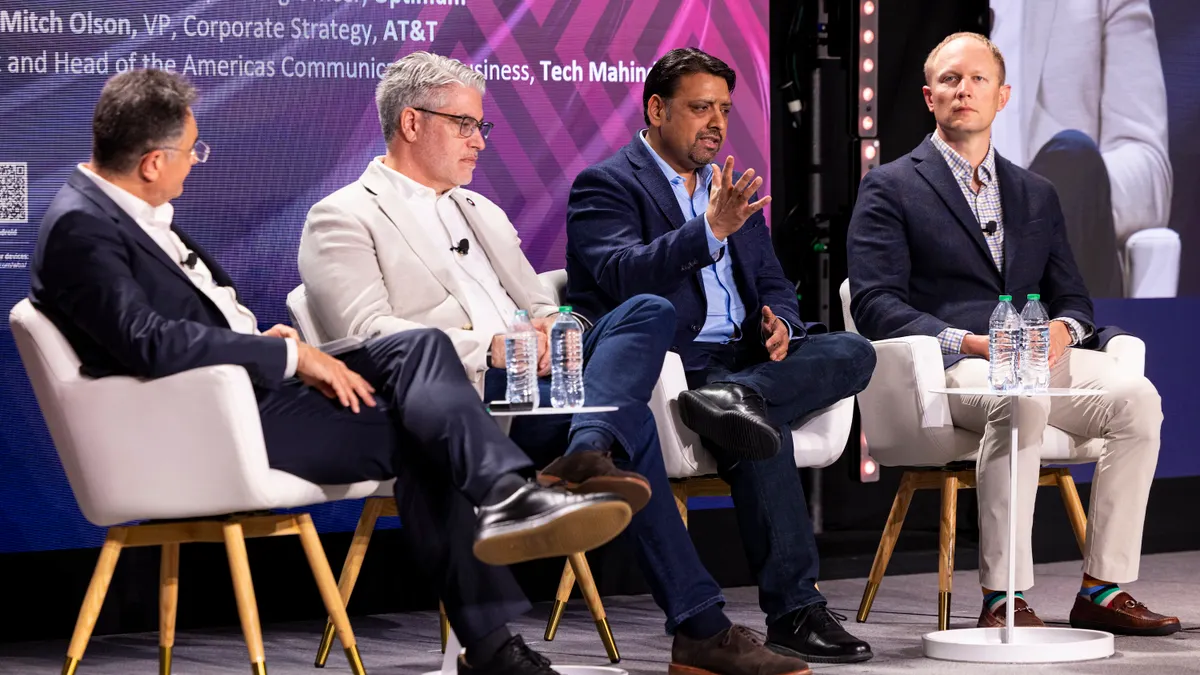
Mangal used his keynote panel at last month’s Network X Americas conference to argue that AI is changing what networks are actually for, not just how they're managed. Partners who understand that shift before their customers do will be in a much better position than those waiting on new technical specs to land.
"The purpose of connectivity now becomes: as the AI intelligence ecosystem builds around us, how do we move it from the source to the consumer in the most optimal way, in the form of a token as a unit?" he told the conference audience. He said the key is to look at connectivity differently, no longer "in the context of bits and bytes anymore."
Very contextual tokens
In a conversation with Channel Dive after the keynote, Mangal put it more sharply. A humanoid robot doing laundry and one responding to a medical emergency are both processing tokens. The network, as currently designed, can't tell the difference and has no way to prioritize one over the other. "Both times you're processing tokens, but these are not voice versus data anymore," he said. "These are very contextual tokens.”
The difference matters because of how tokens travel. When an LLM processes a request, it generates output in a stream of tokens and each one is dependent on the last. That inference process requires a continuous, low-latency connection between the device and wherever the model is running — the cloud, an edge node, a smartphone. Unlike a video stream, which can buffer ahead and absorb network hiccups, AI inference can’t recover the same way, and a stalled token stream means a stalled response. The more consequential the task, the more the network has to get out of the way.
Networks have historically handled prioritization through predetermination. To oversimplify, voice usually got the fast lane and streaming was buffered. Network traffic categories were baked into specs. But that model doesn't work as well when the device making inference requests is a robot assessing whether someone just fell or is having a cardiac event.
“In the new world, there is no predetermination," Mangal said. "It will have to be very contextual."
The change is a few years away, but it has implications for how partners write and sell service agreements. SLAs built around uptime and throughput don't tell an enterprise customer whether their AI workloads are getting what they need. Mangal pointed to “time-to-first-token” as the metric operators and, by extension, partners need to start designing around. "You're not measuring latency now," he said. "You're measuring token reliability — the time it takes for the token to reach from when the request has been made."
None of this is happening at scale yet. Mangal is upfront about that and wasn’t overselling the future. He was urging network operators to think ahead. Most operator conversations today remain focused on using AI to cut their own costs. The question of how to position the network as a distribution layer for intelligence itself is further out.
The network intelligence machine
Tech Mahindra EVP and chief transformation officer Amol Phadke made the same observation in a piece published last week, drawing an uncomfortable parallel to 5G. The industry was convinced ARPU would follow the massive 5G network investment, and it mostly didn't. His read on what separates operators actually scaling AI from those still running pilots is their operating discipline, not the technology.
Phadke cites McKinsey's February 2026 research as support for the observation. It said that AI-driven network operations can cut operational expenditures by 15% to 30%, but only when workflows are redesigned from scratch, not just automated as they are today.
For partners, the near-term opportunity is more concrete. Tech Mahindra runs hundreds of millions of calls on behalf of telecom operators globally and has built more than 200 AI agents for customer service. The part that should interest channel partners goes beyond the cost savings. Tech Mahindra said that satisfied customers buy more, and the company is now willing to include that in the contract.
"We will commit to you those upsides," Mangal said in the interview. "We are that confident in our agents." He declined to name specific operator customers with those contracts, citing confidentiality.
Internally, about a year ago, Tech Mahindra trained 77,000 employees on AI through a tiered certification program — white, brown, and black belts — with the baseline being that every employee can identify, specify, and visualize AI use cases in their jobs.
The business case Mangal is making to network operators also applies to the partners who serve them. Stop selling the old broadband metrics and start understanding what customers are trying to do with it. "If you orient your thinking and actions around the purpose of the customer, they will buy connectivity anyways,” he told Channel Dive. He added that partners who ask their enterprise customers today how AI-intensive their environments are becoming and what those workloads actually need from the network will have a head start on everyone waiting for the specs to tell them.
Using customer satisfaction to create a sales opportunity is not new. But Tech Mahindra's approach uses sufficient customer interaction data to train AI agents to satisfy customer requests while simultaneously upselling new services. Then it commits contractually to its customers on how and where revenue will improve. When that kind of competition shows up, it will put a lot more pressure on channel partners who are still pitching AI purely as a way to cut costs.