
Ask channel partners how they register deals with their vendors and you'll hear the same routine. Log in to the portal, find the form, retype what's already in their own CRM, then wait. Multiply that by every vendor they sell for and it's easy to see why so many registrations arrive late, incomplete or not at all.
Vendors tend to read that as low commitment. Usually it's friction. A partner who sells for eight or ten vendors isn't choosing between your program and a competitor's. They're choosing between your admin, from registering the deal to updating it and chasing your team for news and getting back to their customer.
The channel programs that keep partners active have stopped making the portal the only way in. Here's what they do differently.
Why channel partners stop registering deals
Most channel programs are designed from the vendor's side of the table. The portal is where the vendor tracks registrations, publishes content and runs reporting. For the partner, it's one more tab. Their real work happens in their CRM, their inbox and their team chat.
The result is a lack of partner activity. Partners sign the agreement, finish onboarding, get their credentials and go quiet. A handful drive most of the revenue. The rest send deal updates by email or WhatsApp, or a spreadsheet at month end and channel managers spend their week retyping and chasing. Partner engagement looks low on the dashboard, but much of the activity is there. It just isn't happening in the portal.
Let channel partners register deals where they already work
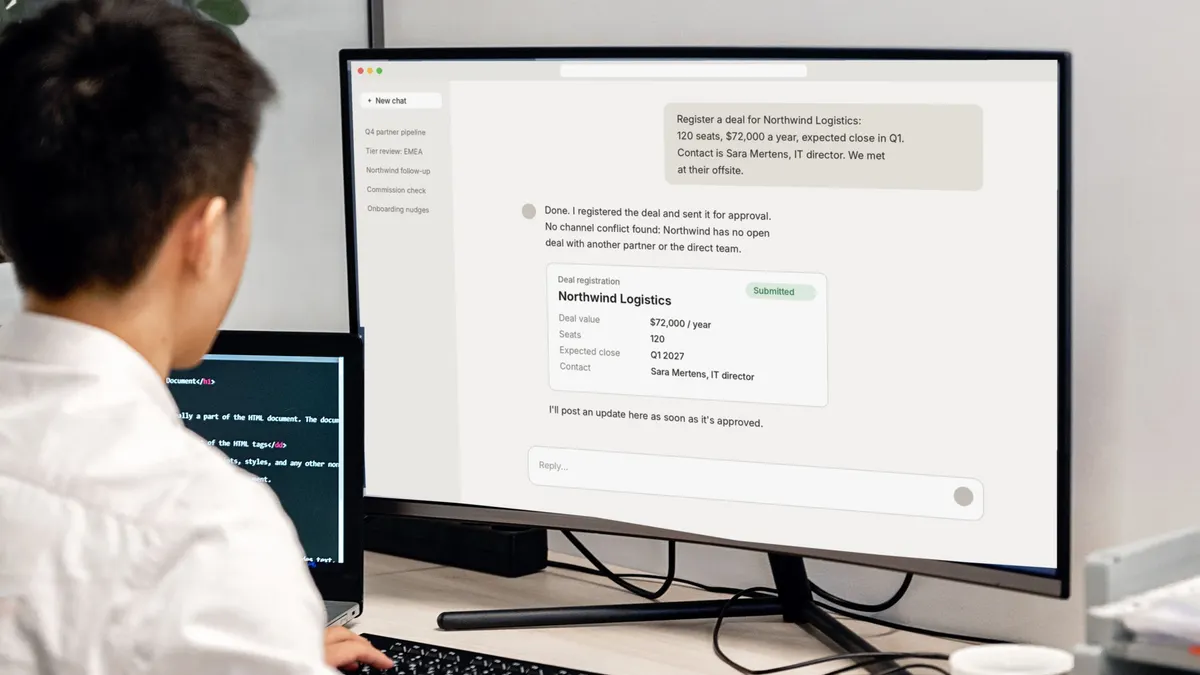
The portal still matters. It sets the rules of the program and holds what partners come back for, such as training, certifications, pricing and an overview of their shared deals. But registering a deal shouldn't require a separate login. Partners should be able to submit one from the tools they already use: a shared Slack or Microsoft Teams channel, email, their own CRM and, increasingly, an AI assistant like Claude or ChatGPT.
And don't stop at registering deals. Partners should be able to ask for the right battlecard, case study or price list, check the status of the deals they registered and see how much commission they'll receive, all from those same tools. A partner who asks for the latest pricing in a shared channel, or asks their AI assistant where a deal stands, should get an answer in seconds, without opening the portal.
Go headless: set the rules once, apply them everywhere
The next step is a headless channel program. The portal stops being the place partners must go and becomes the place you set the rules: what each partner can see, do and earn. Those rules then follow the partner into their AI assistant, their chat tools and their own CRM. That opens up use cases a portal never could:
- Deal registration: a partner registers a deal in about 90 seconds from Claude, Slack, email or their own CRM, just by describing it. The agent asks for anything missing and writes it to your CRM.
- Deal coaching: every partner deal gets guidance for its segment, delivered in the partner's own workspace instead of a portal.
- Enablement support: partners get answers 24/7, in their own language, in chat or their AI assistant, so your channel managers stop fielding the same questions.
- Commissions and incentives: partners check commission status and tier progress in seconds, with no portal login and no ticket to finance.
- Shared deals: your sales rep opens the deal in the CRM and works with the partner on the same record, without going to other tools.
Because every surface reads the same rules and writes back to the CRM, partners and your sales team see the same deal and channel leaders get attribution numbers that sales and finance don't dispute.
Let AI handle the follow-up, with humans in the loop
Much of a channel manager's week goes to prep, follow-up and admin. AI agents now take a growing share of it, so you spend that time with partners instead:
- Preparing QBRs: an agent drafts the review in seconds from the partner's pipeline, goal progress, activity and commission status. You spend 15 minutes editing instead of hours assembling, so every partner gets a QBR, not only your strategic few.
- Following up after the meeting: from the recording, the agent pulls out decisions and action items, creates tasks for the partner and drafts the follow-up email the same day.
- Spotting partners who stall: the agent flags partners with no deal months after onboarding, or deals untouched for two weeks and suggests the next move: a call, a warm lead or a short course.
- Clearing approvals: routine deal registrations and MDF requests that meet your rules are approved in seconds. Exceptions land with you, with the failed rule, partner history and a recommendation attached.
- Answering program questions: ask "Which Gold partners haven't registered a deal in 60 days?" in Slack or Claude and get the answer in seconds, plus a weekly digest of wins, at-risk partners and pending approvals.
The guardrail matters. Agents should take scoped actions and a person should approve anything that touches money, contracts or a customer. Used that way, AI gives channel managers their hours back for joint planning, deal strategy and time with partners.
What this looks like in practice
Ringover, a cloud communication platform for sales, support and recruitment teams, saw the same pattern. Its channel ran across disconnected tools, with little visibility into which partners were engaged and only 20% of partners were active.
Ringover moved to Introw, a partner platform connected to its CRM, with self-service deal registration, automated re-engagement and partner support around the clock. Partners submitted 200+ leads in the first three months, more than 80% of them qualifying and partner activity rose from 20% to over 70% (source). Partners didn't become more committed overnight. The program just became easier to act on.