Dive Brief:
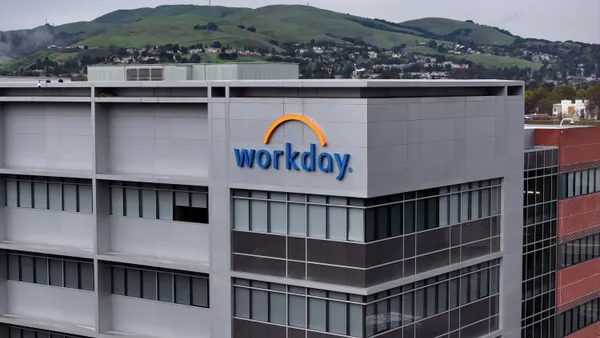
- Workday Co-founder and CEO Aneel Bhusri framed the next fiscal year as a new chapter with AI agents as major players in the cloud-based software company’s ongoing saga.
- “When we founded Workday, we transformed the enterprise by reimagining HR and finance in the cloud,” Bhusri said Tuesday during a Q4 2026 earnings call for the three months ended Jan. 31. “Now we have the opportunity to transform it again by reimagining HR and finance with AI and taking advantage of this new vector of growth.”
- Bhusri replaced Carl Eschenbach as CEO on Feb. 6 after a two-year hiatus, during which he served as executive chair of the Workday board. The executive shuffle followed a punishing 12 months that saw the company’s stock price cut in half as the market braced for AI’s impact on the enterprise software industry.
Dive Insight:
Bhusri sought to reassure investors on Tuesday with an AI-friendly narrative, emphasizing the technology’s value in the Workday human resource and financial management software suite.
“Marrying the best system of record for HR and finance with the reasoning capabilities of domain-specific LLMs — that's the future,” Bhusri said. “It's like peanut butter and jelly. They just go together.”
Workday’s financial report largely supported the framing.
The company’s subscription revenue grew 15.7% in Q4 and 14.5% for the fiscal year that ended in January, to $2.4 billion and $8.3 billion, respectively. Total revenue was up 13.1% to $9.6 billion in FY2025, with gross revenue retention rates holding firm at 97%, according to CFO Zane Rowe.
“Workday’s results show the ‘real world’ enterprise business is holding up very well and there is strong evidence that Workday is not operationally ‘broken’ whatsoever,” Forrester Senior Analyst Akshara Naik Lopez told Channel Dive. “Investors aren’t punishing what Workday did last quarter; they’re repricing what it might face next — slower growth guidance, elongated deal cycles in some sectors and a rising belief that AI could reshape the economics of application software.”
Bhusri pushed back against concerns that AI would eat into revenue.
“Our application domains are really, really hard to build,” Bhusri said. “These are true systems of record that must process transactions with absolute accuracy and speed, enforce complex security models and comply with statutory and regulatory requirements all over the world. No amount of vibe coding is going to produce an HR or an ERP system.”
Workday’s strategy follows a now familiar software vendor script: Provide customers with an array of AI tools and charge for add-ons. The company built up its AI arsenal through M&A moves over the last two years, acquiring AI recruitment tool HiredScore, document intelligence platform Evisort, talent acquisition assistant Paradox and agent-builder Flowise.
Workday in November completed its purchase of AI startup Sana, which yielded the Sana Core and Sana Enterprise AI assistants, and they are now in general availability as of Feb. 15. The company is rolling out a bevy of role-based AI agents that have been in preview, Gerrit Kazmaier, president of product and technology, said Tuesday.
The flurry of AI activity may have had unintended consequences, according to Naik Lopez.
“Workday’s own messaging of prioritizing agentic AI investment and discussing business-model shifts like consumption-based pricing, may have led to this uncertainty that big changes are coming,” Naik Lopez said. “But enterprise HR and finance systems are high-trust, high-compliance processes and workflows, which typically are slow to be disrupted by organizations. The goal is to keep risk and liability to the minimum.”
The larger story for Workday centers around recurring revenue in the cloud. The company is banking on a hyperscaler billing model, using tiered pricing for companies that run agents on the Workday platform.
“In the same way that they charge for consumption of compute cycles and application cycles, we're going to continue to flex that muscle,” Bhusri said. “There are some vendors out there, including some of our peers that would consider them, at some level, parasites on Workday. They get a free ride on our underlying system of record, and we're going to put an end to that.”