

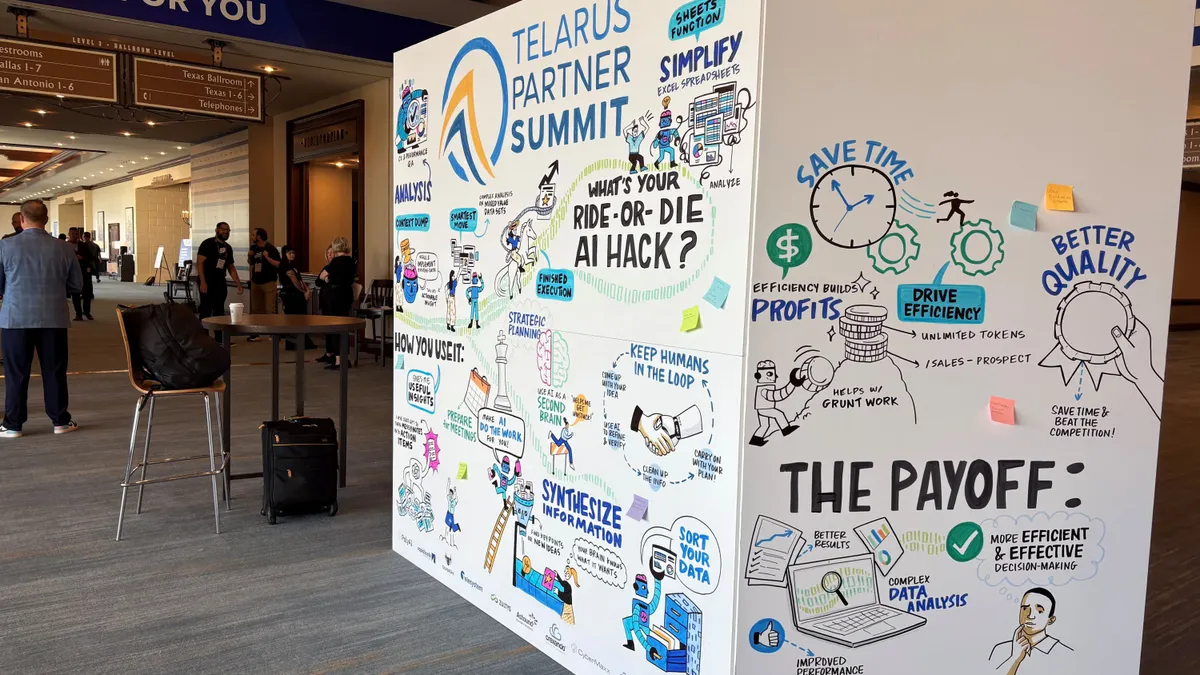
Telarus has built a reputation for post-sales support, but the technology services distributor isn’t resting on its laurels as it tests digital platform enhancements and rivals jockey for back-office supremacy.
“They gave us a few areas of opportunity that we've been laser-focused on,” Chief Customer Officer Julie Peoples told Channel Dive at the annual Telarus Partner Summit in Dallas. “They wanted us to be faster. They wanted us to be more accurate. They wanted us to streamline some procedures, create fewer communications and use more human intervention when it's needed most.”
The Columbia Capital-backed technology services distributor is building software collaboratively with its technology advisor partners. Telarus interviewed 92 TAs in the last 12 months en route to deploying 1,202 features/applications on the Telarus Hub platform, according to SVP of technology Michael Brown. TAs are signing up as guinea pigs to test new digital product features through Telarus Labs, an incubation hub announced at last year’s summit.
The company has also firmed up its partner support strategy under Peoples, a former wealth management executive who joined Telarus late in 2024. She’s leading a support organization that often flies under the radar — unless partners encounter a problem.
“What we find is, sales is great at growing the number of advisors and engaging them,” Telarus CEO Adam Edwards said. “But support is really where the experience and the promise is fulfilled, and that's how we retain it.”
The company now on average registers deals with vendors in less than an hour and quotes back to TAs in less than two hours. It shortened response time for commission inquiries by 113% on average from October 2025 to March 2026, and reduced the time to resolve a supplier inquiry by 20 days since the beginning of 2026, according to Peoples.
Those are metrics TSDs track internally but don’t always share.
“We're talking about them because we're so confident that we're delivering at the highest level, and we've always tracked these things,” Peoples said. “And truthfully, from my conversations with advisors from my very first day, they've always intimated that they thought Telarus was best-in-class from a support perspective, but they believe these refinements would create a more seamless experience for them.”
Proactive support is key for the firm. The company has recovered $53 million in commissions without partners making inquiries in the last year, Peoples said.
TSDs function as the backstop for partners, which are typically lean organizations with minimal time and resources to track down information about their vendor partners.
“If we're not sure what's going on, something slipped through the cracks or maybe there's a disconnect we weren't expecting, [TSDs] are always there and can be more reactive,” C3 Technology Advisors VP of Operations Taylor Rose said. “Not every TSD is like that. There's definitely others out there, but that's something where Telarus has great strength.”
Telarus Chief Commercial Officer Richard Murray said the firm has historically been shy about its work behind the scenes.
“I think we've always done more around the commission's experience than any of them,” Murray said. “It's just not really in our culture to take credit for the things that we do.”
However, partner support has been a point of major competition over the last few years. Avant’s acquisition of PlanetOne signaled a major back-office push, and Sandler Partners has promoted its commissions recovery track record for years.
“Going back several years, [the Telarus] platform was much more advanced in terms of the post-sales side of the house,” Rose said. “But other TSDs are starting to catch up to them.”
Platform development gets fast and collaborative
Digital platforms are another competitive area for TSDs. Telarus has raced to position its portals against Avant’s Pathfinder sales enablement platform.
The company launched the Telarus Hub business management platform in March 2025, coaxing its legacy partners off the sunsetting predecessor. Now the company is leaning on collaboration with TAs and an internal LLM built by a frontier modelmaker to speed up software projects. One upgrade uses AI to ingest PDFs and fill out order information that previously required painstaking manual labor.
“We've seen this very lucky coincidence that we moved to a platform, and now we've got the capabilities of AI that we do today, which those two together are really making us very very nimble,” Brown said.
Telarus has gotten a boost from TA partners that have upped their AI skills by leaning into vibecoding to tailor software to specific business parameters. Some firms have made applications available to peers. ForgeOS, Catch Advisors and Socium IT are among the partners-turned-providers.
Murray said Telarus has ceded territory toward those bespoke providers, focusing on integrations with ISVs and TAs where collaboration makes sense.
“We're no longer of the opinion that we have to build everything ourselves,” Brown said. “If somebody else out there has a business that's focused on that, why wouldn't we then just integrate with them and provide that goodness back to our partners?”
In the TA model, TSDs are an intermediary between vendors and partners, relaying not just sales commissions, but also information. Historically, TSDs collect quotes, orders and cash from suppliers and pass them on to partners. The future dynamic may look less like a hand-off, if the Telarus model holds.
“How do we make it not a game of telephone and have it almost instant-sync across platforms?” Rose said.