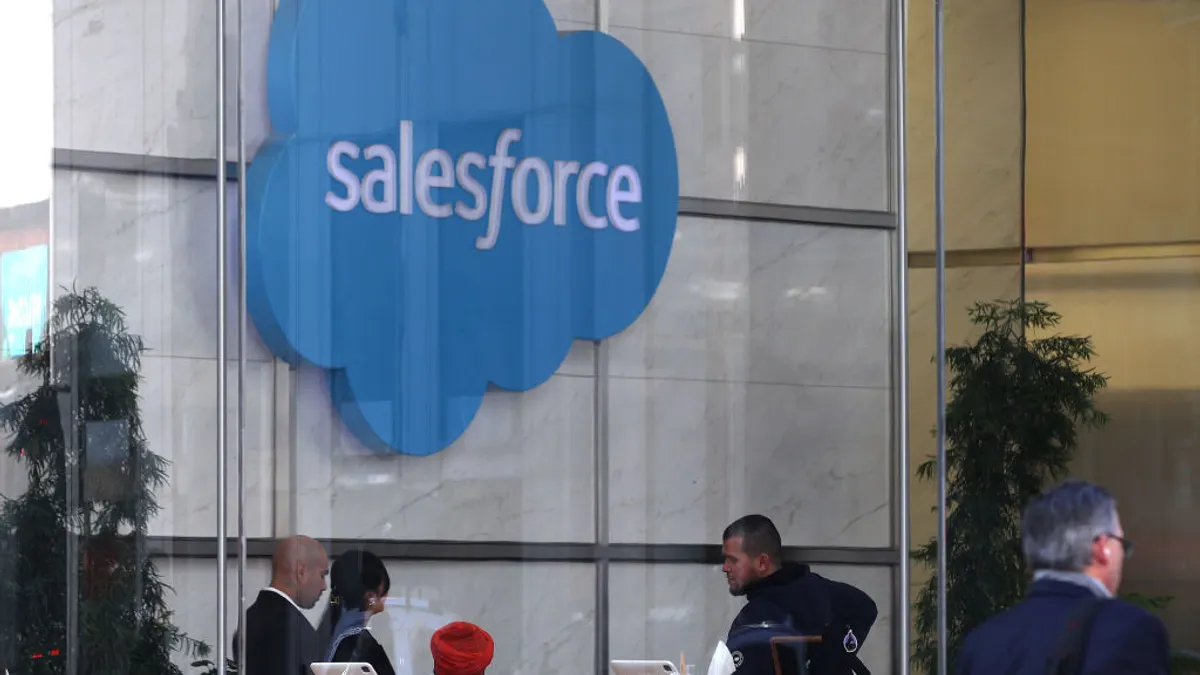
The SaaSpocalypse is nothing to fear, Salesforce CEO Marc Benioff assured investors Wednesday during a video earnings call from the Salesforce Tower in San Francisco, emphasizing the company’s continued progress in the AI era.
The rise of agentic AI, which can execute complex tasks across workflows, has triggered market panic in the SaaS industry, but Salesforce maintains that the SaaSpocalypse is not a threat, but an opportunity for expansion and new revenue streams.
As fear of AI-driven SaaS obsolescence mounts, SaaS companies like Salesforce are racing to integrate the very technology threatening to disrupt them.
“You've heard the narrative on the SaaSpocalypse,” Benioff said during the earnings call. “Everybody has heard of this crazy thing: that these AI apps are transforming software, which is definitely true. All our products are so much better because of it.”
Salesforce’s revenue totaled over $11 billion during Q1 FY2027, ended April 30, up 13% year-over-year. Benioff said the company experienced major momentum with its AI products. Annual recurring revenue for AI and Data, including customer data platform Data 360 and AI service assistant Agentforce, reached $3.4 billion in the quarter.
AI strengthened Salesforce operations, with Agentforce handling more service inquiries than humans, according to Benioff. Slackbot, the resident personal assistant on the company’s collaboration platform Slack, increased company productivity by 3%, Salesforce President and CRO Miguel Milano said.
Salesforce executives envision all companies becoming agentic enterprises amid the SaaSpocalypse — reinforcing, not eliminating, the need for Salesforce products like Agentforce. To underscore that point, Benioff asked a customer, Pentagon Federal Credit Union, whether the SaaSpocalypse is impacting how they use Salesforce.
Pentagon Federal Credit Union President and CEO James Schenk was on the call to answer. The financial firm, which specializes in serving the military, runs 76 Salesforce agents across operations, mortgages, IT and HR, saving $1.6 million annually while handling more volume with the same headcount, Schenck said.
Even with the continued demand touted by Salesforce, the AI shift is forcing practical changes across the industry. Many SaaS vendors are rethinking pricing models. Salesforce has expanded Agentforce from consumption-based pricing to include a range of pricing based on action-based models, flexible credits and enterprise licensing options, according to an analysis by Channel Dive sister company Omdia.
While AI may not be killing SaaS, it is changing how SaaS is valued and packaged. Buyers are prioritizing adaptability and AI over pure cost savings, Keith Kirkpatrick, vice president and research director at Futurum, told Channel Dive over email.
“The true potential for AI development lies in extending rather than replacing these SaaS-provided systems,” he said. “AI-assisted development excels at creating ad hoc reports, custom dashboards, and fast integrations, areas where traditional enterprise platforms are often too rigid or costly to customize. SaaS platforms aren't going anywhere, but they will need to continue to align pricing and packaging with value delivered.”
With the AI boom, concerns over AI flattening human employment within the SaaS industry are rising in the channel ecosystem. In March, Salesforce slashed its partner structure, whittling its four-tier structure to two tiers to pivot towards agentic, AI-driven delivery.
During the earnings call, Schenck addressed workforce concerns for enterprises, emphasizing that AI creates "bionic employees" that work alongside agents rather than replacing human workers. "We're not losing employees," Schenck said, referring to Pentagon Federal Credit Union's AI deployment. "We're able to add more volume at scale with the same number of people."
Benioff acknowledged that Salesforce has kept engineering headcount flat at around 15,000 over the last two years by using AI to boost productivity, but emphasized that hiring is still happening in sales.
AI-driven obsolescence is fueling both innovation and fear across the SaaS industry as companies strive to remain relevant in a rapidly evolving landscape. Salesforce's aggressive AI integration strategy is just one high-profile case study to watch.