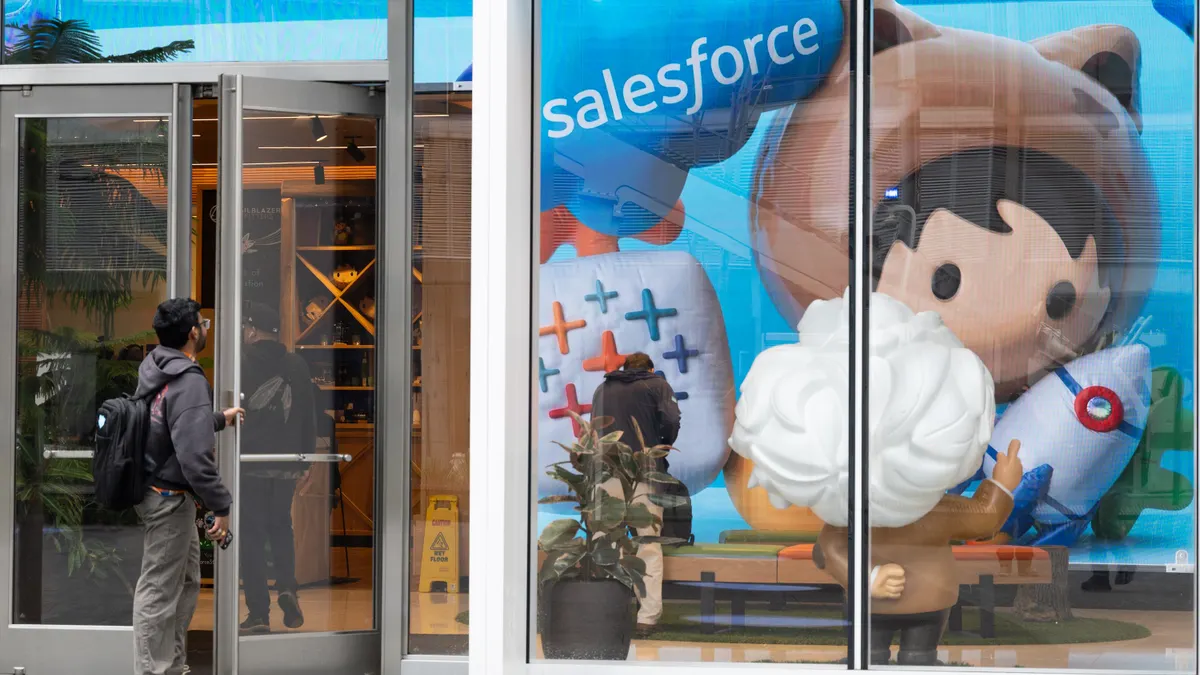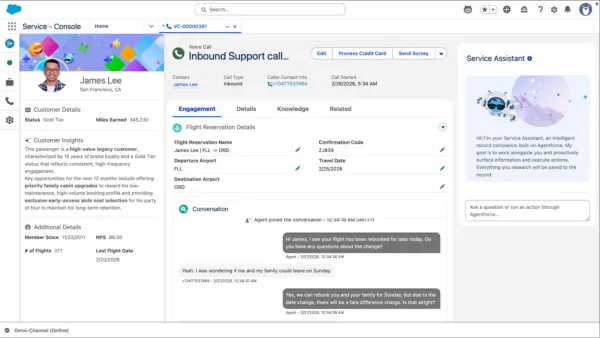


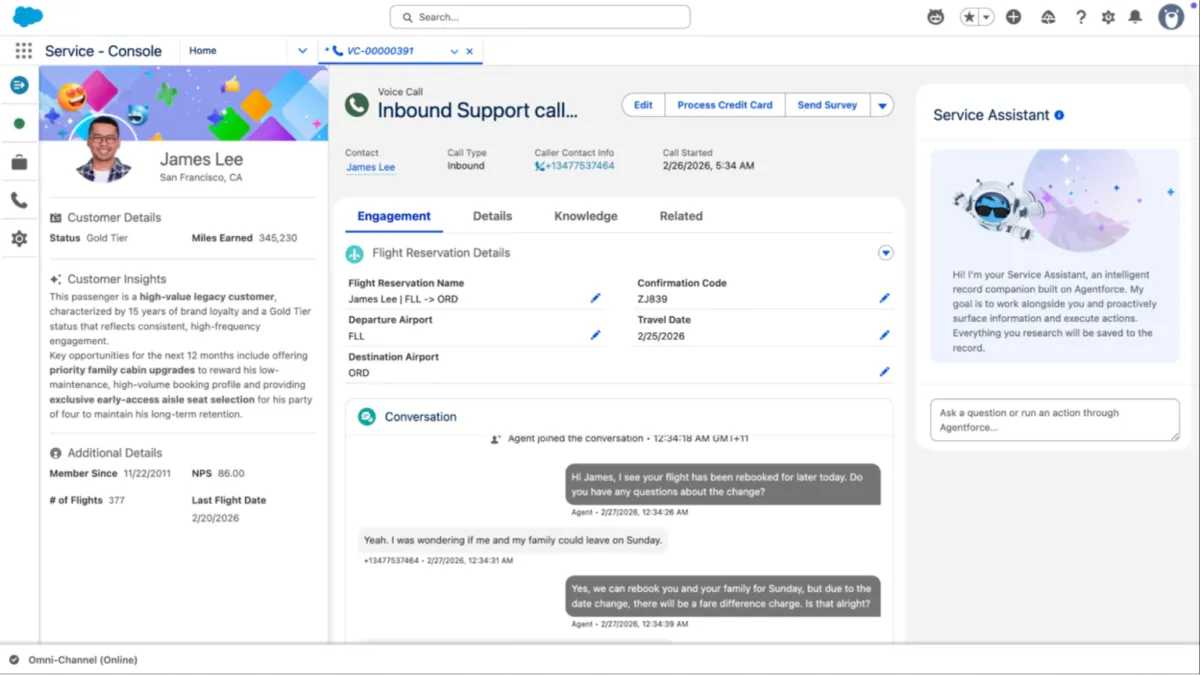
Salesforce sent ripples through its partner ecosystem with the launch of a new contact center solution, which natively offers capabilities the software giant has been borrowing from third-party software and voice partners.
Salesforce executives touted Agentforce Contact Center as the only unified platform with native contact center, CRM and virtual AI agents capabilities during a Monday press briefing. The product represents the inevitable marriage of CRM and contact center, Kishan Chetan, EVP and GM of Agentforce Service at Salesforce, said, adding it’s an “iPhone moment” where a single product unifies disparate systems.
“The customer data is in different systems, which are not fully connected, which leads to not the best personalization and broken experiences,” Chetan told reporters and analysts.
It’s not the vendor’s first foray into contact-center-as-a-service; the company rolled out the Salesforce Contact Center offering in 2022. But the latest platform eschews Salesforce’s prior strategy, which leaned on independent software vendors to integrate voice services and contact center capabilities into Salesforce Service Cloud.
With the move, Salesforce became frenemies with a segment of its partner ecosystem. The company specifically called out “legacy contact center tools,” many of which are partner integrations.
“Contact centers patched together with a variety of legacy tools cannot bridge the gap between AI and CRM,” Chetan said. “By treating voice, AI, and CRM as a single service nervous system, we give human and AI teams the shared context they need to turn every interaction into a resolution.”
With Agentforce Contact Center, Salesforce has effectively flipped the script on its integration-first strategy, according to SalesforceDevops.net Senior Industry Analyst Vernon Keenan.
“Salesforce said something important in 2023. They said they did not want to become a contact center company. On March 10, 2026, they became one,” Keenan said.
But the move is logical. Salesforce trotted out clients such as Compass Working Capital, which praised the benefits of a unified platform.
“They're not a contact center company; they're a CRM company, but they think they've seen enough of their customers and probably had enough requests around, 'Can you guys do more in this space?'” Kairos Data Communications Partner and CRO Lucas Salvage told Channel Dive.
Salesforce’s side of the story
Salesforce executives downplayed the platform’s competitive implications.
“Yes, there will be places where we have overlapping capabilities and customers who look at both options, but I think at the end of the day, it's customer choice and we’ll ensure that we have the same integrations and the same visual look and feel for both Agentforce Contact Center and all of our partners,” Chetan said.
The company's bring-your-own-telephony and bring-your-own-contact-center options will continue and receive deeper investment, Chetan said.
Salesforce shouted out its system integration partners, including Accenture, Deloitte, IBM and PWC. Asked by Channel Dive whether Agentforce Contact Center will be available for partners in resale and referral motions, Chetan only gave a ‘yes’ to resale in what was something of a non-answer.
“We'll continue to kind of keep evolving our channel motion. A lot of our products that are available broadly in the Salesforce price list do go through resale, because depending on the market we operate in, depending on the geography, depending on the sector, we do have sellers reselling our capabilities,” he said. “So that's a set of relationships that's super crucial for Salesforce, and we'll continue with that for all of our product lines, including Agentforce Contact Center.”
ISV diplomacy
CCaaS vendors tripped over themselves in 2025 to integrate deeper with Salesforce.
Genesys last summer announced a $1.5 billion investment from Salesforce and ServiceNow amid increased integration with the Service Cloud platform. Genesys, in a statement to Channel Dive, said customers want flexibility in their platforms.
“Salesforce remains a valued strategic partner, and our collaboration through CX Cloud from Genesys and Salesforce continues to play an important role for hundreds of customers who want to combine CRM and enterprise-grade experience orchestration,” Kyle Kuntz, VP Strategic Technology Partnerships, Genesys said in an email. “Demand remains high for the [Genesys] CX Cloud solution as many organizations are accelerating their interest for deeper agentic orchestration using both human and AI agents that work across systems to power the next phase of customer experience. Agentforce Contact Center introduces another native option within the Salesforce portfolio for organizations with simpler requirements to consider.”
Emphasis on “simpler requirements.” CCaaS-focused ISVs are betting they have the specialization and tenure needed to meet the business's higher requirements.
“We’re seeing many enterprises, particularly those with complex, global or highly regulated environments, continue to prioritize proven, enterprise-scale CCaaS platforms with advanced capabilities spanning voice, digital, outbound and workforce engagement management,” Kuntz said.
NiCE started as a bring-your-own telephony provider for Salesforce Service Cloud in 2022, moved to a bring-your-own contact center provider, and most recently integrated with Salesforce Data Cloud.
"Recent movements in the industry reinforce just how strategic customer engagement has become for enterprises,” NiCE’s Jon Levine, VP of Alliances, said in a statement. “CX AI is now mission-critical — and enterprises need mature, enterprise-grade platforms to operationalize it with confidence. NiCE brings decades of CCaaS and AI leadership, delivering the performance, governance, and breadth complex global enterprises rely on."
Salvage, whose company brokers CCaaS platforms from NiCE, Genesys and other Salesforce ISVs, expects a civil response from those vendors. But when those ISVs conduct sales training with their partners, they’ll draw upon weaknesses in Salesforce’s new platform.
“They'll publicize those gaps, publicize those challenges, and remind everybody: ‘Salesforce is a CRM company,’” Salvage said.
Salvage said the move is reminiscent of Microsoft offering its own voice offering for Teams, which businesses have ditched en masse for third-party solutions in recent years.
“People jumped on it, and then they found out that there are hundreds of limitations around what it could do, versus what a RingCentral, a Dialpad, Vonage, those kinds of companies already had,” he said.
Microsoft also launched a CCaaS offering in 2024, promising a unified CCaaS solution with its popular Teams conferencing platform.
Salvage said many clients have examined Microsoft’s CCaaS offering and found it wanting.
“Most have said, 'No, it just doesn't have the same capabilities, analytics and stability,’” he said.
That being said, he thinks it’s easier for a CRM to launch into UCaaS than for a UC provider.
“A CRM is typically interfacing with some kind of contact center platform. Usually there's some tie-in there, so I think [Salesforce] probably has a little bit more skin in that game,” he said.