The most successful channel partners are turning to emerging technologies to scale their businesses. IntraSystems, a 30-year-old, Massachusetts-based IT service provider and MSSP, is no different.
Like many channel partners, the company — which specializes in the health care, wealth management and education verticals — is trying to figure out how best to incorporate AI into its solutions.
For IntraSystems, that’s where D&H Distributing comes in.
“D&H buys into the technology themselves,” Michelle Page, VP of operations at IntraSystems, a D&H partner, told Channel Dive. “They understand how to use it, and they implement it into their own processes. They then bring it to us, tell us what they’re doing — and what’s working.”
Partners and customers have long regarded D&H, one of the largest privately held distributors in North America, as strong among SMBs. Now, eight months after launching its Advanced Solutions+ business unit, the company is competing with its larger, publicly traded rivals for upper midmarket and enterprise customers.
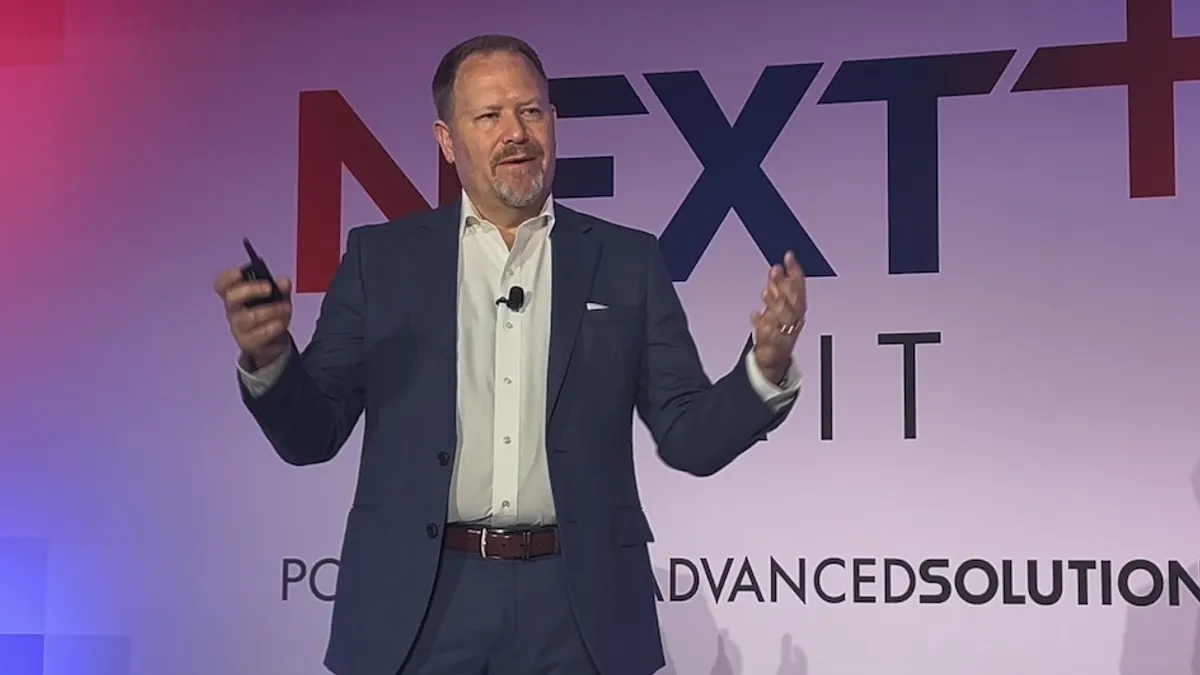
D&H introduced its Advanced Solutions+ business unit at NEXT+, the company’s inaugural conference held in Austin, Texas, earlier this month.
Even before the launch, the company grew its services revenue. After a couple of down years for overall IT distribution sales, the market rebounded in 2025. D&H touted double- and triple-digit year-over-year revenue gains across its portfolio, with professional services and infrastructure revenues more than tripling, and cloud services and security increasing by 70% and 63%, respectively. AI components, including data center power and cooling gear, were a major driver of the recovery.
Momentum continued into 2026 as the company rolled out the advanced solutions division.
Jason Bystrak, SVP of Advanced Solutions+, said the evolution started in 2019 when he joined the company to lead its cloud efforts. Since D&H was already actively working with partners on high-growth solutions opportunities, the debut of Advanced Solutions+ last fall was more of a rebrand than a launch.
“We wanted to create a hybrid experience that’s a one-stop shop, to be able to work with [partners] to create a multivendor solution, [design] the services that wrap around it and then decide how the end customer wants to consume those solutions,” said Bystrak. “Then we craft that together and walk side by side with them to take it to market and be successful.”
D&H invested millions of dollars in the business unit, which has a staff of 300 people focused on sales, marketing, technical support, channel and business development.
The company also committed resources to training channel partners.
The partner investments paid off, according to Henry Ngo, SVP at systems integrator Golden Star Technology, a Southern California-based D&H channel partner specializing in federal government technology contracts.
“D&H has made huge investments in high computing, server and storage, with all of the major OEMs,” said Ngo. “We can really rely on D&H with the resources to go after these new opportunities.”
Increasingly, that has meant not only more diverse customers, but larger ones. The biggest prompt for the shift might be D&H partners who are seeing a huge demand — particularly in new technology and services — from their customers.
“Our partners are pulling us into the upper midmarket and lower enterprise,” said Colin Blair, VP of cybersecurity and emerging technologies at D&H. “That really precipitated us needing to reevaluate our value proposition, and that continues to happen every quarter.”
As traditional distribution moves toward services-oriented models, the most successful partners are those making significant investments in their managed services practices, Bystrak told Channel Dive.
“In some cases, they are consuming some of our managed services and white-labeling them; other times, they do a lot more of the heavy lifting themselves,” he said. “The better partners are looking to cross the solutions stack and are integrating different categories. A successful partner is one that’s looking to expand their footprint.”