

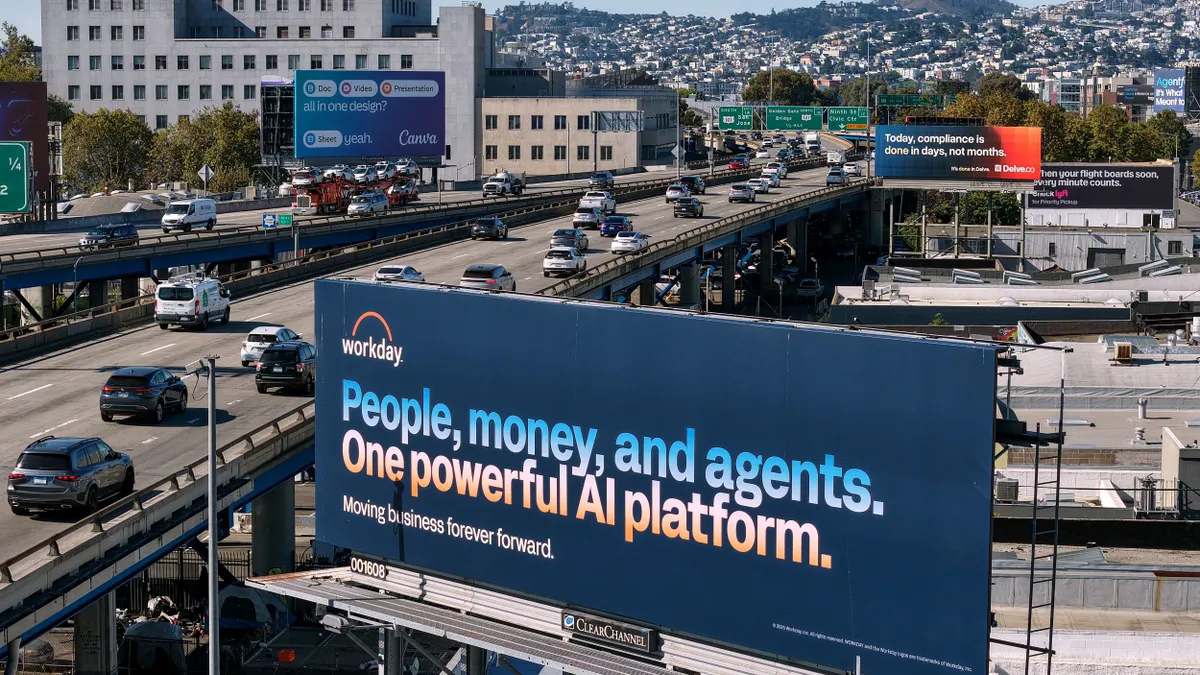
Workday partners expect significant growth opportunities with the SaaS provider as it pushes beyond its human capital management roots, adds AI capabilities and opens its platform to more third-party offerings.
IT service provider executives said Workday's unfolding strategy will give their customers more options to use the platform, not just as a point product, but as part of an end-to-end set of software offerings. This wider use could translate into higher revenue from consulting and systems integration projects. Partners can also generate more business by layering their offerings on top of Workday, as many already do with Salesforce and ServiceNow.
Channel partners have become more central to Workday's business over the past few years. As of the company's second fiscal quarter, which ended July 31, they represented more than 20% of its net-new annual contract value, compared with less than 3% two years ago.
Here are a few recent Workday moves that have piqued partner interest:
- The company completed its purchase of Paradox, an AI agent focusing on candidate hiring tasks such as applications and interview coordination, on Oct. 1. The deal gave Workday a complete "talent acquisition suite," according to the announcement. Other acquisitions include Workday's August purchase of Flowise, a low-code platform for building AI agents, and the pending purchase of AI-based search and agent vendor Sana.
- In September, at its annual Workday Rising conference, the company unveiled Workday Data Cloud, which shares data between Workday and other vendor platforms, including Databricks, Salesforce and Snowflake. Separately, Workday launched an agentic AI platform partnership with Microsoft.
- Workday forged partnerships with Accenture, Deloitte, KPMG, PwC and several other enterprise vendors to deploy their tools on its platform. Partners build AI agents that link with the Workday Agent System of Record, an agent governance and monitoring hub.
Multi-vendor alliances
Workday’s recent moves opened its platform to a broader range of customer needs, according to IT services executives who spoke with Channel Dive.
Jannine Zucker, principal and global chief commercial officer for Workday alliance at Deloitte, cited [Workday’s] partnerships with Salesforce and Microsoft as examples of "how open things are going to become."
Deloitte will be able to work more holistically with its clients, Zucker said.
PwC has taken a wide-angle view as it explores use cases that span Workday and Salesforce. The consultancy is building a lead-to-ledger offering that takes sales leads captured in Salesforce, handles pricing and quoting, and, if the opportunity converts, recognizes the win in a customer's Workday general ledger system.
The PwC integration depends on getting Salesforce agents to "shake hands" with Workday agents on the financial side, Claudio Valera, PwC global and U.S. Workday alliance leader at PwC said. That process can be orchestrated using PwC's agent OS, a tool for coordinating multiple agents. Workday's Flowise, which includes multi-agent workflow orchestration, could also be used, Valera said.
Another PwC offering links Workday with Guidewire's software for property and casualty insurers.
"We are looking at multi-alliances," Valera said. "I sort of view it as a solar system. Workday is the sun, and we have all of the other planets that we make sure are connected around that particular sun."
Patrick Pugh, PwC’s global and U.S. alliances leader, cited the importance of connectivity among the orbiting platforms.
"The reality is that with the size and the complexity of most companies today, no single technology drives transformation," he said.
Integrating to tackle complex problems
The expanding Workday universe is critical as enterprises seek to escape pilot mode and think more broadly about returns on AI investments.
Deloitte clients are weighing the relative advantages of Workday features against other vendor offerings, according to Zucker.
"The outside of Workday part, before [the September partnership announcements] was a little bit more, 'How is that going to work with Workday?" she said. There has been a shift to say, 'Workday is going to allow me to leverage agents that are outside, with agents that are in Workday.'"
The Workday suite has also evolved its financial offerings to stake a broader claim in enterprise software, including ERP, West Monroe Senior Partner Kim Seals told Channel Dive.
Workday now has a "truly competitive ERP solution," Seals said, noting the ability to tie together its financial and human capital management software will help differentiate the company.
Seals, who oversees the consulting firm’s Workday alliance, said her clients want to combine people, finance and operations data to track productivity and make faster decisions.
"Workday has become a much more obvious solution for that than perhaps in the past," she said.
Process improvements
Against the backdrop of Workday's expanding portfolio, ecosystem partners point to several growth opportunities.
Seals said West Monroe aims to grow its Workday-related revenue in three key areas: advisory and strategy consulting, change management and adoption support, and business process optimization. The firm has been building its Workday consulting team, tapping the vendor's alliance program to stay ahead of technology developments.
"One of our predominant reasons for joining the partnership program was to get access to the training and to get access to the advanced notices on the product releases," Seals said.
PwC, meanwhile, finds that business process improvement opportunities arise from Workday software implementation.
"Yes, there's a technology aspect that's critical, but [customers] really look at us to transform the workforce, finance and operational processes,” Pugh said.
In addition to services, partners said they can deploy their intellectual property to expand Workday project revenue.
"Workday provides us with this amazing canvas to be innovative and to build solutions on their technology or complementary technologies," Valera said.
PwC uses Workday’s low-code developer toolkit Extend to build industry-specific and cross-industry applications.
Deloitte also takes an industry-focused approach. In 2024, the company launched a series of Workday accelerators with preconfigured processes, data models and workflows for the healthcare, technology and media, banking, higher education and investment management sectors.
Dan Sundt, human capital leader for Workday alliance at Deloitte, said such offerings help the company align with client needs by industry or sectors within a particular industry.
"That's an area that we will continue to really focus on and co-innovate with Workday," he said.