

Dive Brief:
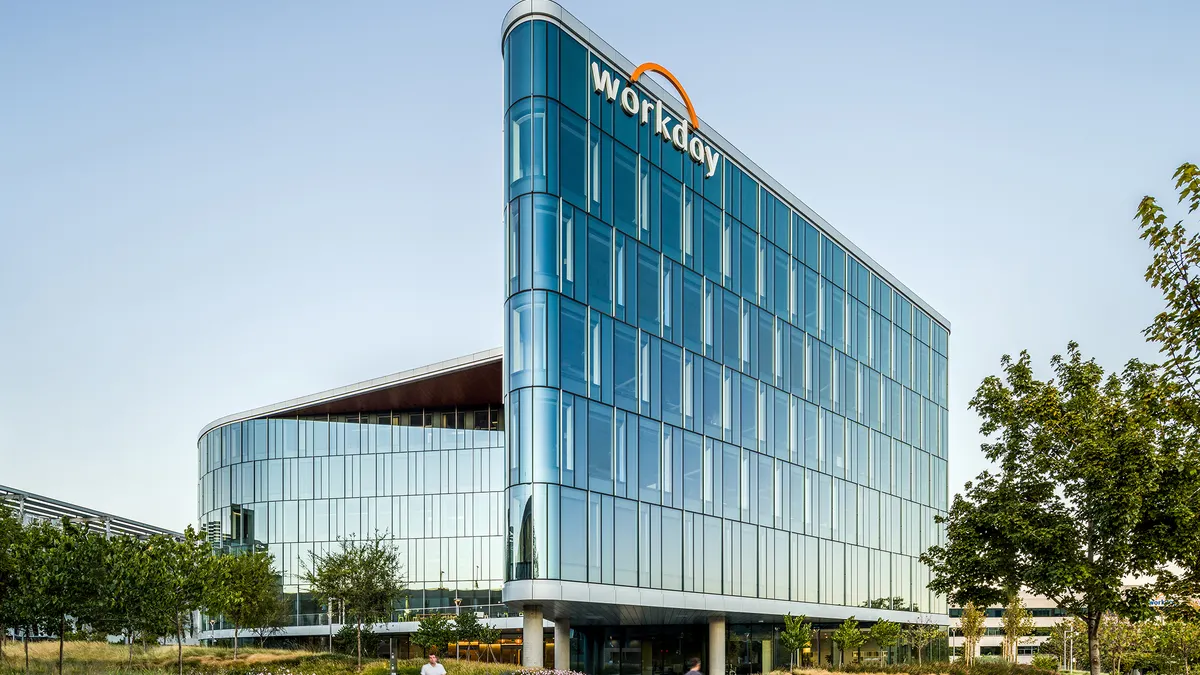
- Workday terminated CEO Carl Eschenbach, firing the executive Feb. 6 without cause, just two days after announcing layoffs for 2% of its workforce. Eschenbach will collect $3.6 million in severance and 164,000 shares of Workday stock and will serve as a strategic advisor to the CEO, according to the separation agreement.
- Eschenbach, became Co-CEO in 2022 and sole CEO in 2024 and helped push the company’s share price to a record high of $294 in 2024. The stock has steadily fallen since mid-2025, driven in part by fears that widespread AI usage will reduce the number of enterprise SaaS seats.
- Co-founder and executive chair Aneel Bhusri has returned to the role of CEO. The company’s board is counting on him to accelerate product development in the age of AI. “We’re now entering one of the most pivotal moments in our history. AI is a bigger transformation than SaaS — and it will define the next generation of market leaders,” Bhusri said in an announcement Feb. 9.
Dive Insight:
Workday’s decision to fire its CEO reflects persistent challenges in the ERP market and the broader software industry.
The company’s stock has lost more than 40% of its value in the last 12 months. Rivals Oracle and SAP are down 11% and 25%, respectively, over the same period, but they’ve seen a bump since Workday’s announcement. Investors worry the replacement of human employees by AI agents will cause SaaS companies to sell fewer licenses. Furthermore, the remaining employees could use AI-based vibe coding tools to reduce their reliance on legacy software applications.
But Workday’s board has bigger issues than a portended SaaSpocalypse. The executive swap could signal an increased investment in research and development to position the company a winner in the age of AI. Bloomberg Intelligence analyst Anurag Rana said Bhrusi “could accelerate product development to infuse more AI tools across its platform.”
Workday has already been touting its advancements in AI, but the company is looking for an in-house approach in 2026.
Eschenbach oversaw five acquisitions in 2024 and 2025, bringing the company back into the M&A for the first time since 2021. Workday purchased AI agent builder Flowise, conversational AI provider Paradox and learning management system Sana in the second half of 2025.
A cut of 8.5% of Workday’s headcount, announced in early 2025, helped make room for the aggressive acquisition push. Though the company enjoyed 13% revenue growth in its third quarter, Individual investor and Seeking Alpha contributor Gytis Zizys said Workday relied on short-term revenue gains from acquisitions.
“Overall, the company looked decent at first glance, but once everyone started to dig into the report more closely, the company’s performance was not due to organic growth but rather through M&A strategy, which isn’t ideal. It is still growing, but it begs the question of how sustainable such a strategy will be in the future,” Zizys wrote in a November analysis of the company’s Q3 earnings.
Workday thanked Eschenbach for increasing its operational discipline.
The company did not respond to a request for comment from Channel Dive as of publication time.
An internal R&D push and cuts to Workday’s direct sales force could raise the profile of channel partners as the company’s go-to-market engine. Partners sourced more than 20% of Workday’s net new annual contract value in Q3, as opposed to 3% in 2023. Moreover, partners are a key bridge to the volatile mid-market.
As Workday projects a partner-friendly attitude, systems integrators and consultancies are increasing their services for the software suite. Large partners such as PwC and Deloitte are increasingly tying their own intellectual property to Workday’s tools.
“Workday provides us with this amazing canvas to be innovative and to build solutions on their technology or complementary technologies,” Claudio Valera, PwC global and U.S. Workday alliance leader at PwC, told Channel Dive last year.