Dive Brief:
- Global semiconductor revenues will surpass $1.3 trillion this year, increasing 64% compared to 2025, according to a Wednesday Gartner report. The analyst firm expects the market to grow 17% to nearly $1.6 trillion next year as demand begins to level off.
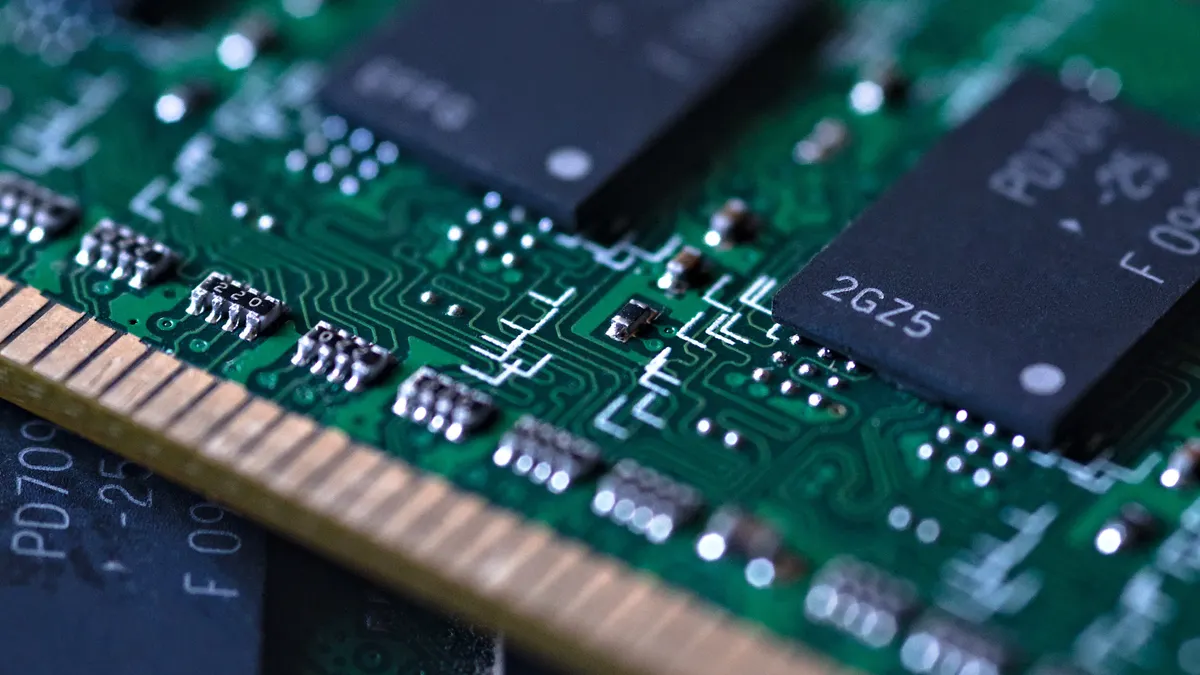
- An AI building boom continues to consume available semiconductor resources, driving across-the-board price inflation in components. Memory and storage costs have been particularly hard hit, with prices for Dynamic random-access memory and NAND flash chips on course to spike by 125% and 243%, respectively, this year, the analysis found.
- The trend, which Gartner dubbed "memflation," will "destroy — or at least delay — non-AI demand into 2028, to varying degrees depending on the application,” Rajeev Rajput, senior principal analyst at the firm, said in the announcement. “Technology suppliers should prepare for higher prices during the first half of 2026, followed by persistent but moderating price increases throughout the rest of the year.”
Dive Insight:
Unprecedented hyperscaler spending has wreaked havoc on semiconductor supply chains, as infrastructure to support AI workloads diverts traditional compute resources.
This year, Gartner expects semiconductors to account for roughly 30% of the global semiconductor market, with cloud providers increasing AI infrastructure spending by more than 50% year over year.
The spending jag has been a boon for semiconductor vendors and a pain point for unlucky buyers. “CIOs and IT leaders should be cautious about signing supply agreements with unfavorable pricing terms that extend beyond 2027,” Rajput said.
PC shipments increased 9.1% year over year in Q4 2025, as vendors signaled cost increases and buyers braced for prices to spike. The server market finished the year with a 52.4% growth spurt, driving the global market to record highs for the year, according to IDC.
As the center of gravity shifted further toward hyperscalers and GPUs, Micron Technology and other chip manufacturers adjusted production, exacerbating shortages of solid-state drives and other core PC and server components.
GPU giant Nvidia surpassed Samsung as the largest semiconductor provider by revenue for the first time late last year, as AI processors surpassed $200 billion in sales, according to a Gartner analysis published in January.
Cloud’s pull on production was evident in the playbook Micron Technology CEO, President and Chairman Sanjay Mehrotra outlined for investors during a Q2 2026 earnings call last month.
“Data center is becoming a bigger and bigger part of the industry,” Mehrotra said. “So of course, bigger portion of the supply goes there, and that's the main driver of growth for the industry as well as for Micron itself.”
As shortages hit other parts of the IT market, PC and server vendors jacked up prices, passing added costs on to the channel. More than 70% of partners reported price increases, and over 90% had experienced shipment delays this year, according to a March report by analyst firm Omdia, a Channel Dive sister company.