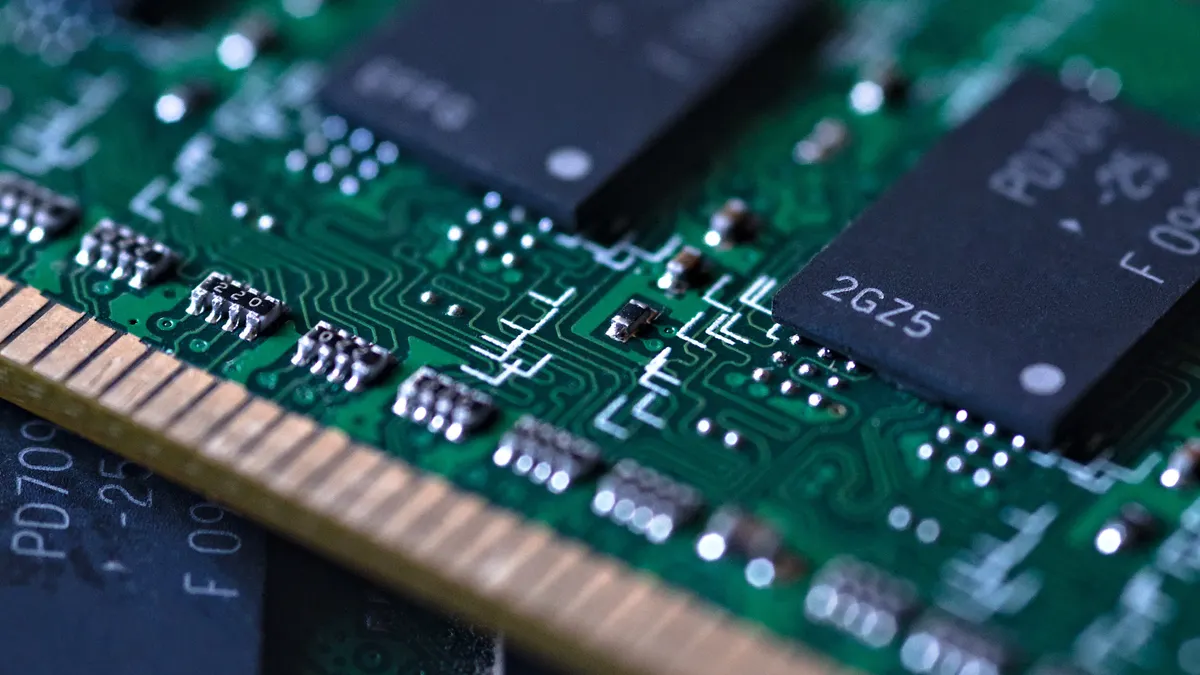
The tech industry began the year bracing for the impact of component shortages triggered by a race to build out data centers for unprecedented AI workloads. Instead of GPUs, the focus of a prior wave of supply chain uncertainty, the humble memory chip and more unassuming cousins in storage took center stage in a drama that now seems poised to play out into 2027.
Costs have spiked, according to recent Omdia research. The analyst firm, a Channel Dive sister company, estimates that memory and storage configuration prices have increased by between $90 to $160 since Q1 2025, up 60% year-over-year. In the PC industry — one of the first to feel fallout from the capacity crunch — Omdia expects sticker shock to take a bite out of global shipments, which are projected to decline as much as 15%.
The blast radius expanded during Q1, hitting servers, networking gear and other hardware categories embedded with memory and storage components. HPE is repricing contracts and offering customers alternative configuration recommendations as part of a three-pronged plan to alleviate supply chain strains.
“We expect elevated prices to persist well into 2027,” the company’s President and CEO Antonio Neri said during a recent earnings call:
Cisco, another major channel supplier, also acknowledged that it was revising contractual terms to address the situation. “We have already announced price increases, and we’ll continue to monitor market trends and make additional adjustments as necessary,” the company’s Chair and CEO Chuck Robbins told investors last month.
Partners are caught between their customers’ IT budget constraints and vendor price hikes that are creeping upward and outward.
“As an industry, we're expecting prices to increase 15% or so on average and volume to units to decline kind of just barely low single digits,” Joyce Muller, CEO and director of IT reseller and management firm Insight Enterprises, said during a February earnings call. “It will cause a bit more caution as customers decide which investments to make in terms of infrastructure and how it will play out.”
Channel Dive asked several channel partners how they were navigating the situation. Here’s what three of them had to say:
RapidScale President Duane Barnes
Managed cloud services provider RapidScale acted quickly on vendor signals that prices were about to climb late last year, the company’s President Duane Barnes said.
“We did a pre-buy in December, well ahead of customer demand, and bought pallets worth of hardware,” he told Channel Dive. That action was spurred by warnings issued by Dell, which raised server prices on Dec. 10 and, less than a month later, across its Client Solutions Group portfolio.
RapidScale doubled down last month when Cisco signaled an impending price increase. “We did another pre-buy to get ahead of that price increase, and I think largely that will help us kind of over the summer if we're in competitive situations,” Barnes said.
“Not only is it the first time I can remember we've ever done a pre-buy, but we did it in back-to-back 60-days,” he added. “We bought more than a year's worth of capacity because the prices were just doubling and tripling.”
Barnes acknowledged that the fallout would hurt some channel organizations more than others.
“We've got a much lower hardware cost than most of our competitors would have had that didn't do pre-buys, especially — unfortunately — the smaller guys that probably aren't able to go spend millions of dollars ahead of time,” said Barnes. “This is going to be a challenge for the next couple of years, where the small guys are going to get squeezed out.”
CDW Storage and Server Practice Lead Eryn Broadsky
As its business leaders look to scale AI, IT solutions provider CDW has seen the focus of its customer conversations shift to hardware, Eryn Broadsky, the company’s storage and server practice lead, said.
“Since mid-December, I feel like all I'm talking about is architecture because of the supply chain constraints,” Broadsky told Channel Dive. “The memory and storage supply chain situation is forcing us to reevaluate the way that we are architecting data centers.”
The concerns have rippled out from PC procurements to much larger investments.
“There's no area within the industry that hasn't been affected by this,” Broadsky said. “Rather than focusing on the price and availability of a specific component, we look at the business goal and how to achieve that business goal. Then, as price and availability fluctuate, you still are able to reach those business milestones.”
Broadsky stressed that offloading workloads isn’t a replacement for sound architectural planning.
“We have to understand that we are going through a period of unprecedented constraint and change,” Broadsky said. “The cloud is not insulated from this. This is going to hit our cloud providers and the hyperscalers, too, because hardware is still hardware.”
Ensono Chief AI Officer Jim Piazza
Managed service provider Ensono has thus far evaded much of the fallout from chip shortages, but the company is already beginning to focus on optimizing memory and storage as it scales AI internally and for its customers, Chief AI Officer Jim Piazza said.
“The demands that are being placed across the infrastructure portfolio are great,” Piazza said. “So, we are seeing a spike, but it will normalize out.”
A new paradigm calls for a more careful thinking about how compute resources are consumed. Memory costs weren’t a big consideration even a year ago, so optimization wasn’t a priority.
“Memory got to be so cheap you’d just buy the latest and greatest, and it wouldn’t matter, because the difference amounted to pennies,” he said.
Ensono is considering small language models that are more efficiently designed for specific enterprise tasks. There’s also room for optimization in memory usage patterns.
Piazza pointed to data storage as a model for navigating the temporary memory component crunch. “We need to adopt a tiering strategy for how we think about where we hold the data. How do we get it out of the really expensive fast memory as soon as possible,” he said.
Ensono hasn’t had to change its AI strategy, but that could be in the cards if the crisis continues, Piazza said. In the meantime, the company is focused on a mindful approach to resource consumption.
“Every time we go to do anything, whether it's an agentic workflow or to build a small language model, we go through the planning aspect,” said Piazza. “A key question is, how much is this going to cost in terms of raw dollars and cents, or in the sense of, ‘what am I doing with my infrastructure that will prevent me from doing three other things that I want to get done?’”
Channel Dive’s James Anderson contributed to this article.