

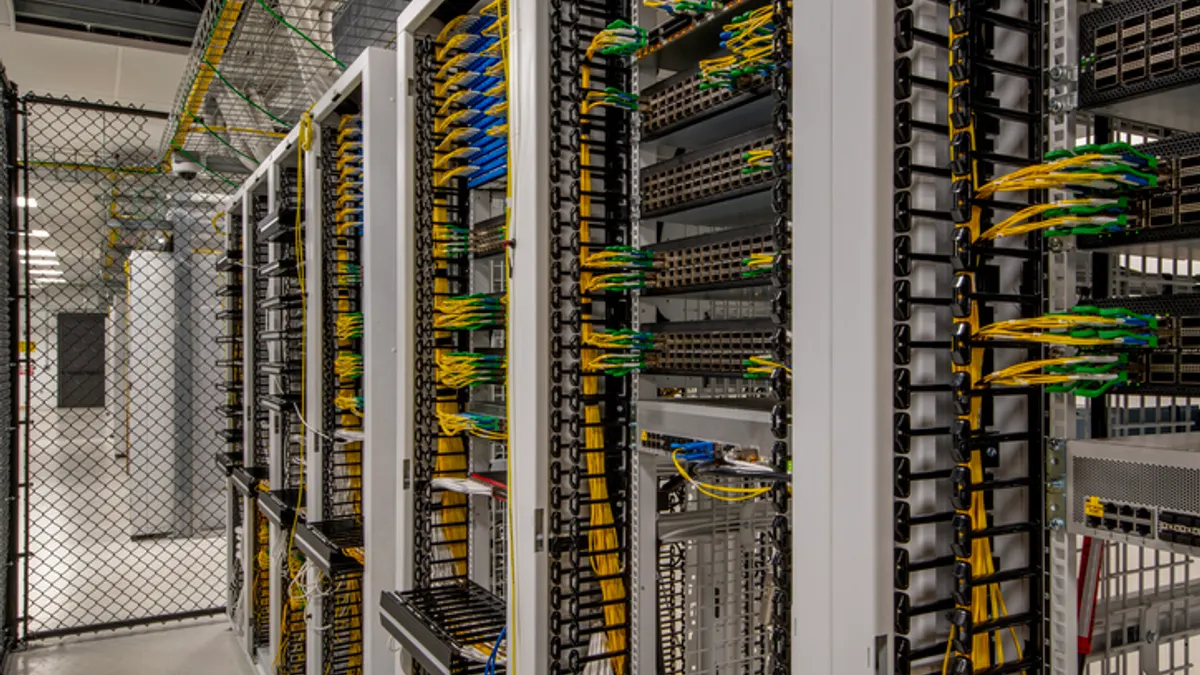
Fidium, a fiber network provider serving 20-plus states, has joined the Flexential Marketplace, giving enterprises, carriers and hyperscalers on-net access to its fiber services inside Flexential data centers in North Texas and Southeastern Minnesota.
Flexential operates more than 40 data centers across 18 markets on a 100 Gbit/s private network backbone that supports colocation, cloud, connectivity and data protection through its FlexAnywhere platform. The Fidium agreement adds high-capacity fiber to that marketplace, covering 100 Gbit/s and 800 Gbit/s wavelength services, Ethernet, and dark fiber.
To appreciate what those speeds mean in practical terms: an 800G connection is capable of transferring the equivalent of 25 HD movies in under one second, according to network test and measurement specialist Viavi. And, of course, it's eight times the capacity of a 100G connection, the standard that until recently defined what a fast enterprise WAN link looked like. For AI workloads moving massive datasets between GPU clusters across facilities, the gap between 100G and 800G is more than an incremental upgrade.
The deal extends Fidium's data center reach across a footprint of 100-plus on-net and near-net facilities, backed by $1.9 billion in fiber infrastructure investment since 2020. But more interesting for channel partners is the story of what's driving the expansion: a shift in what data center customers are asking for.
"Without fiber connectivity, data centers and AI factories are just expensive cold storage sites, stranding billions in capital," said Sean Baillie, SVP of carrier, channel, data center and hyperscale at Fidium, in an email to Channel Dive.
Baillie says customer requests have shifted dramatically in the past 12 to 24 months. Where 100G connections once covered most workloads, 400G is now routine and 800G inquiries are increasingly common.
Why? AI's extraordinary computing needs require data centers to scale up, scale out and scale across.
Scale-up networking, the connections within a single AI compute rack, requires 504 times the bandwidth of a traditional WAN link, according to data from Cisco Systems, as reported by Light Reading. Scale-out networking, which connects racks within a data center, runs at 56 times the baseline, according to Cisco’s data. Finally, scale-across, the inter-data-center connectivity that kicks in when a single facility runs out of power or space for a growing GPU cluster, comes in at 14 times.
As you might expect, these connections need to be nearly real-time, hence the emphasis on cutting edge optics. Baillie said latency has moved "from a checkbox to a hard requirement," particularly for AI training and inference workloads spanning GPU clusters across multiple facilities.
Baillie frames 800G as an architectural inevitability. "When you look at what's happening inside hyperscale and enterprise AI data centers right now, you have dense GPU clusters that are interconnected at the 400G, 800G and terabit-level bandwidth within the facility," he said.
"When those workloads need to extend beyond a single data center, whether for distributed training, model synchronization, or feeding inference endpoints, the interconnect bandwidth requirement follows. You can't build an 800G internal fabric and then bottleneck it at 100G on the WAN. The economics and the performance profile break down."
Carrier options needed
Carrier diversity is emerging as an equally urgent priority, and one that should resonate with telco agents and connectivity resellers who already preach a multi-provider approach to their customers.
Baillie says data center operators are actively diversifying away from single-provider dependence to avoid bandwidth scarcity that could create operational bottlenecks and long-term competitive disadvantage.
For channel partners, that's an opening. Customers building out AI infrastructure aren't just buying more bandwidth; they're rethinking how many providers they rely on and where those providers connect.
Site selection for the Flexential expansion wasn't opportunistic, Baillie said. It was driven by committed customer demand from hyperscalers, neocloud providers and enterprises. And they're not slowing down.
"We will continue to focus on the Dallas/Fort Worth metro and other key Texas markets: Austin, San Antonio, and Houston," he said. The same goes for Minnesota, where Baillie said Fidium is seeing connectivity demand rise steadily across large hyperscale projects and enterprise networks. Fidium also views Pittsburgh, Northern New England and the Bay Area as strategic markets.