The clamor and hype in tech right now surround GPUs, clouds and SaaS giants. But follow the money and you’ll find the center of gravity lies within the channel — in managed services.
Omdia Chief Analyst Jay McBain argued in a recent webinar that managed services have become perhaps the biggest, fastest-growing engine in the entire tech stack. His remarks were part of the MSP Evolution virtual event held on November 20. The managed services market is 1.5 times larger than both the global SaaS industry and all the hyperscalers combined, yet it still doesn’t get “the same love from Wall Street,” McBain said.
That’s a head-scratcher, given that managed services comprise “a big portion of our customers’ budget, and it's growing at 13%,” McBain said.
The global economy has grown 2.2% in 2025, while the broader tech industry has expanded 7%. More than 335,000 companies worldwide now hold at least one managed services contract, and McBain expects the strongest gains to continue into 2026.
For managed service providers, traction starts with product sales but certainly doesn’t end there. For every hardware dollar sold via Palo Alto Networks, CrowdStrike, Microsoft and others, $2 of services are attached. Hardware vendors know that they must enable MSPs, McBain said.
“They have to build out the tech integrations so that managed service providers can come in and manage these environments, connect the dots and implement,” he said.
Much of the reason comes down to one stark reality: partners own most of the vendors’ total addressable market.
“Alliances are key in this world,” McBain said. “MSPs are in the room. They're trusted … They’re not going to recommend something that’s too costly or doesn’t drive great outcomes, because they’re outcome-based. They’re there with the customer forever.”
That alignment bodes well for the channel — and the numbers back projections.
Services dominate spend
Tech has represented the fastest-growing industry for 50 years, and it likely will stay that way for another 20, McBain said.
But survival isn’t guaranteed. More than half of Fortune 500 companies from two decades ago no longer exist, and 71% of tech firms never make it to their 10th birthday, he said. The firms that do succeed will thrive on services.
Here’s how the numbers break down, according to McBain: Of roughly $5.3 trillion in global tech spend, about $1 trillion each goes to hardware and software. The remaining two-thirds flows into services split between telco and tech. Managed services alone account for $608 billion, with 82% of customers outsourcing some or all IT and 15–20% of their total budgets going to those initiatives.
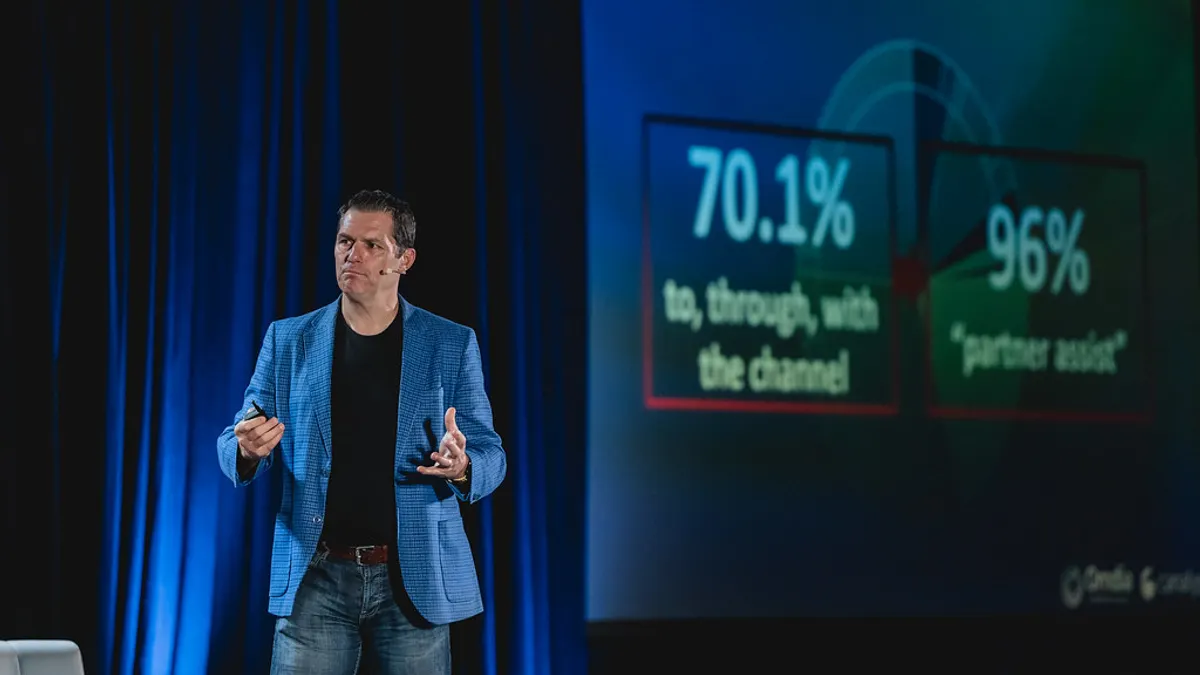
And most of that happens within the channel. For 2025, 70.1% of tech will have been sold through partners, McBain said.
“But the conversation we're having really is that 96% of this industry does partner-assisted in some way,” he said.
Citing McKinsey & Company data, McBain said an average mid-market or enterprise deal now involves seven partners.
And where hardware once accounted for 84% of a partner’s business, it now represents just 16% of revenue and 13% of profit. Managed services, meanwhile, have climbed to 27% of revenue across value added resellers, integrators, solution providers and MSPs. Most partners — 84% —now generate managed services income, marking a major jump from 2024.
AI affords opportunity
The most significant growth areas are cybersecurity and agentic AI, with the latter leading.
“This is actually the No. 1 opportunity, as we look out for the next five years,” McBain said.
Omdia estimates $59 billion in generative and agentic AI services this year, with that figure growing to $267 billion by 2030. That’s the fastest growth rate of any services segment, per McBain. Right now, 44% of partners already build or deploy software agents. Omdia expects that figure to hit 64% within 18 months as organizations seek to embed AI into their SaaS and business platforms rather than dealing directly with GPU makers or hyperscalers.
The shift is redefining the MSP business model. More than half of partners now charge for consulting, design and architecture, and about a third are adding project-based work alongside recurring revenue. As such, the average partner now runs 3.2 business models, according to McBain’s calculations, serving customers across the lifecycle — before, during and after the transaction.
The long game
The majority — 82% — of organizations already outsource IT and, at the same time, are struggling to find cyber, AI and infrastructure talent, McBain said. This is where MSPs come in, and they’re uniquely positioned for the long haul because they’re paid for outcomes, not one-offs.
“They’re not going to build something really expensive and unprofitable to manage,” McBain said.
What does that mean for MSPs themselves? That they are in the right business at the exact right inflection point. The timing, McBain said, “is pretty much perfect.”